

Executive Guide 002: 7 Business Processes You Should Automate Before Hiring More People
As businesses grow, so does the volume of work.
Customer enquiries increase. Sales opportunities multiply. More projects need coordination. Reports take longer to prepare. Teams become busier, inboxes become fuller, and operational complexity steadily increases.
For many organizations, the instinctive response is to hire.
- A sales coordinator.
- A project manager.
- An operations executive.
- A customer support specialist.
- An administrative assistant.
While hiring is often necessary, it is not always the right first response.
Many organizations mistakenly solve operational inefficiencies by adding more people to existing processes instead of improving the processes themselves.
Over time, this creates larger teams managing increasingly inefficient workflows. Costs rise, complexity grows, and productivity improvements become harder to achieve.
The most scalable organizations take a different approach.
Before expanding headcount, they examine how work flows across the business. They identify repetitive tasks, manual handoffs, duplicated effort, and operational bottlenecks that can be redesigned, standardized, or automated.
Automation, in this context, is not about replacing people.
It is about increasing the capacity of the people you already have.
This guide introduces seven business processes that consistently create the greatest operational leverage when improved through workflow automation and AI-assisted decision support.
Rather than focusing on technology, the guide focuses on business capability—helping leaders understand where operational improvements can create measurable gains in productivity, customer experience, and organizational scalability.
Why Growing Businesses Keep Hiring
Growth creates pressure.
As customer demand increases, work naturally accumulates across every part of the organization.
Sales teams manage more enquiries.
Operations coordinate more projects.
Customer support handles more requests.
Finance processes more invoices.
Managers spend more time reporting and approving work.
Eventually, leaders face an important decision:
Do we need more people, or do we need a better way of working?
In many organizations, hiring becomes the default solution because operational friction is mistaken for insufficient capacity.
Yet operational friction often has little to do with the size of the team.
It stems from fragmented processes, disconnected systems, inconsistent information, and repetitive manual work that consumes valuable time every day.
Hiring more people into inefficient workflows rarely solves the underlying problem.
It simply distributes the inefficiency across a larger organization.
The Capacity Trap
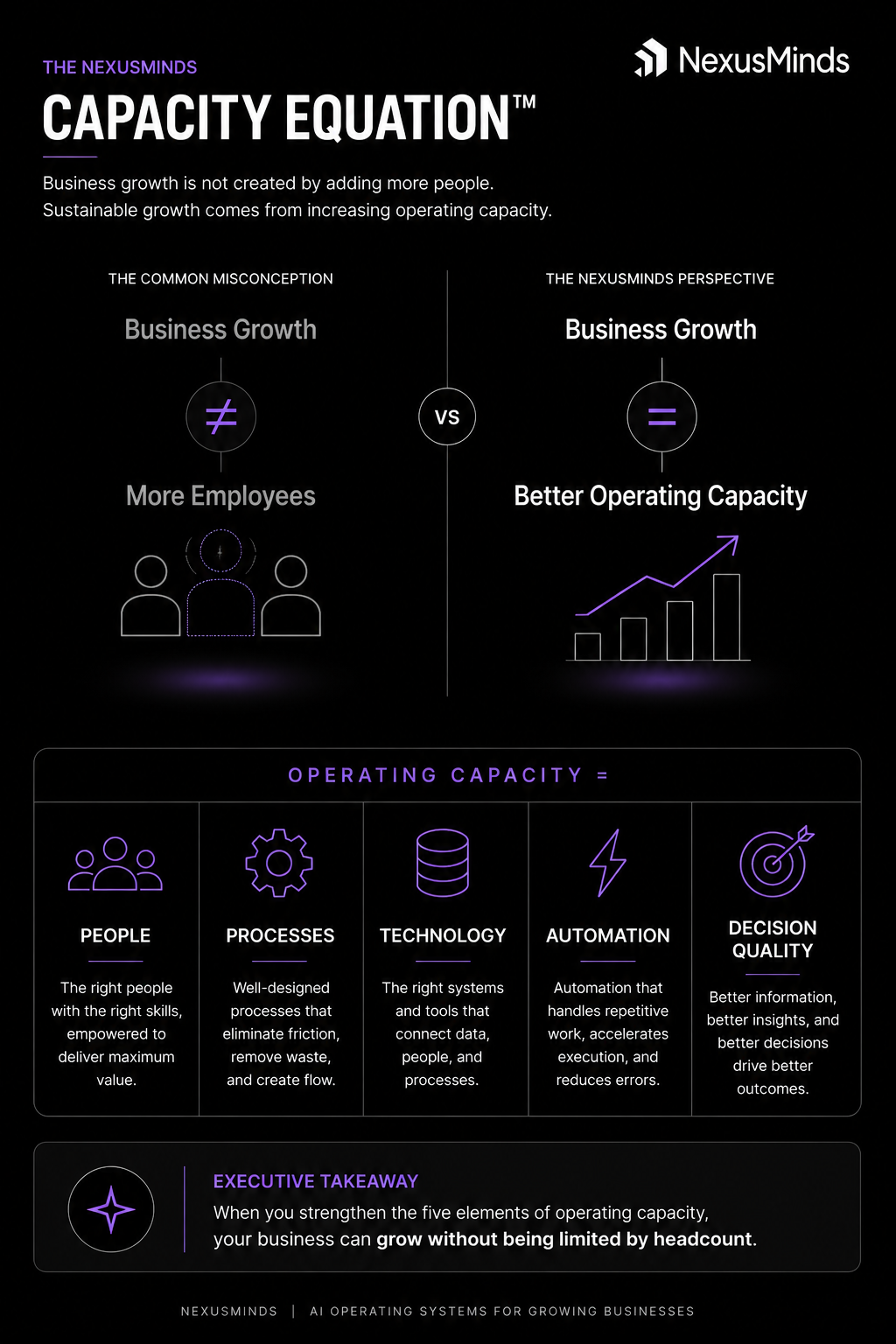
One of the most common misconceptions in growing businesses is the belief that capacity increases in direct proportion to headcount.
In reality, capacity is determined by how effectively people, processes, systems, and information work together.
Consider two organizations with identical teams.
One relies on manual data entry, email approvals, spreadsheets, and disconnected applications.
The other has standardized workflows, automated notifications, centralized information, and AI-assisted decision support.
Although both organizations employ the same number of people, their ability to deliver work is dramatically different.
The difference is not staffing.
The difference is operating capacity.
Organizations that improve operating capacity can often accommodate significantly more customers, projects, and revenue before additional hiring becomes necessary.
The NexusMinds Capacity Equation™
Business growth is not created by adding more people.
Sustainable growth comes from increasing operating capacity.
Executive Insight
Organizations that scale successfully invest in improving how work gets done—not simply increasing the number of people doing it.
People Problem or Process Problem?
When operational pressure builds, it is tempting to assume that teams are understaffed.
Sometimes they are.
More often, however, the underlying issue lies elsewhere.
Questions are answered multiple times because information is difficult to find.
— Customer enquiries are manually copied between systems.
— Managers spend hours consolidating reports from different departments.
— Employees chase approvals through email.
— Sales representatives update CRMs instead of speaking with customers.
— Operations teams repeatedly enter the same information into multiple applications.
These activities consume hundreds of hours each month without creating additional value for customers.
They are symptoms of process design—not staffing levels.
Before hiring additional employees, leaders should ask a different set of questions:
- Which activities are repeated every day?
- Which tasks require little human judgment?
- Where does work frequently stop waiting for approvals or information?
- Which processes rely on copying information between systems?
- Which activities create delays without improving outcomes?
Answering these questions often reveals opportunities to increase organizational capacity without immediately increasing payroll.
The Cost of Manual Work
Manual work carries costs that are rarely visible on a financial statement.
Every repetitive administrative task consumes time that could otherwise be spent solving customer problems, strengthening relationships, or developing new opportunities.
- Manual processes also introduce variability.
- Different employees complete the same task differently.
- Information becomes inconsistent.
- Approvals are delayed.
- Errors increase.
- Knowledge remains locked inside individuals rather than becoming part of the organization’s operating system.
These hidden costs compound as businesses grow.
What feels manageable with ten employees often becomes unsustainable with fifty.
Without deliberate process improvement, growth amplifies operational complexity.
Automation Is About Capacity—Not Cost Cutting
Automation is often misunderstood as a cost-reduction initiative.
While efficiency gains are important, they are rarely the primary objective.
The most successful organizations use automation to increase the value of human work.
Administrative effort decreases.
Decision-making becomes faster.
Information moves more efficiently across departments.
Employees spend less time managing processes and more time delivering expertise.
Rather than replacing people, automation allows organizations to make better use of the capabilities they already possess.
That shift—from replacing effort to expanding capacity—is what enables sustainable growth.
What You'll Learn in This Guide
In the following chapters, we’ll examine seven business processes that consistently create the greatest operational leverage when redesigned and automated.
For each process, you’ll learn:
- Why it becomes a bottleneck as organizations grow.
- The hidden cost of leaving it manual.
- Where workflow automation delivers the greatest value.
- Where AI can enhance judgment and decision-making.
- The measurable business outcomes organizations can expect.
The objective is not to automate everything.
It is to identify the operational capabilities that will create the greatest impact before your next hiring decision.
"The fastest-growing organizations are rarely those with the largest teams. They are the ones that have built operating systems that allow their teams to accomplish more."
NexusMinds Perspective Tweet
Let's begin with one of the most overlooked opportunities in almost every growing business:
Business Process 1
Lead Qualification & Routing
Every business invests significant time and money generating leads.
Yet many organizations still rely on manual processes to determine who should respond, how quickly, and what happens next.
Leads arrive through websites, forms, emails, referrals, advertising campaigns, events, and social channels.
Someone downloads a brochure.
Books a demo.
Requests a proposal.
Submits a contact form.
Messages your sales team.
The problem isn’t generating leads.
It’s what happens after they arrive.
When lead qualification depends entirely on manual effort:
- Manual lead review
- Poor qualification consistency
- Lost enquiries
- CRM updates performed manually
- High-value prospects treated the same as low-value enquiries
When lead qualification depends entirely on manual effort:
- Response times increase.
- Sales teams spend time reviewing poor-fit enquiries.
- High-quality prospects wait longer.
- CRM data becomes inconsistent.
- Pipeline forecasting becomes less reliable.
Over time, this reduces conversion rates without leaders necessarily recognizing the underlying operational cause.
How Mature Organizations Redesign This Process
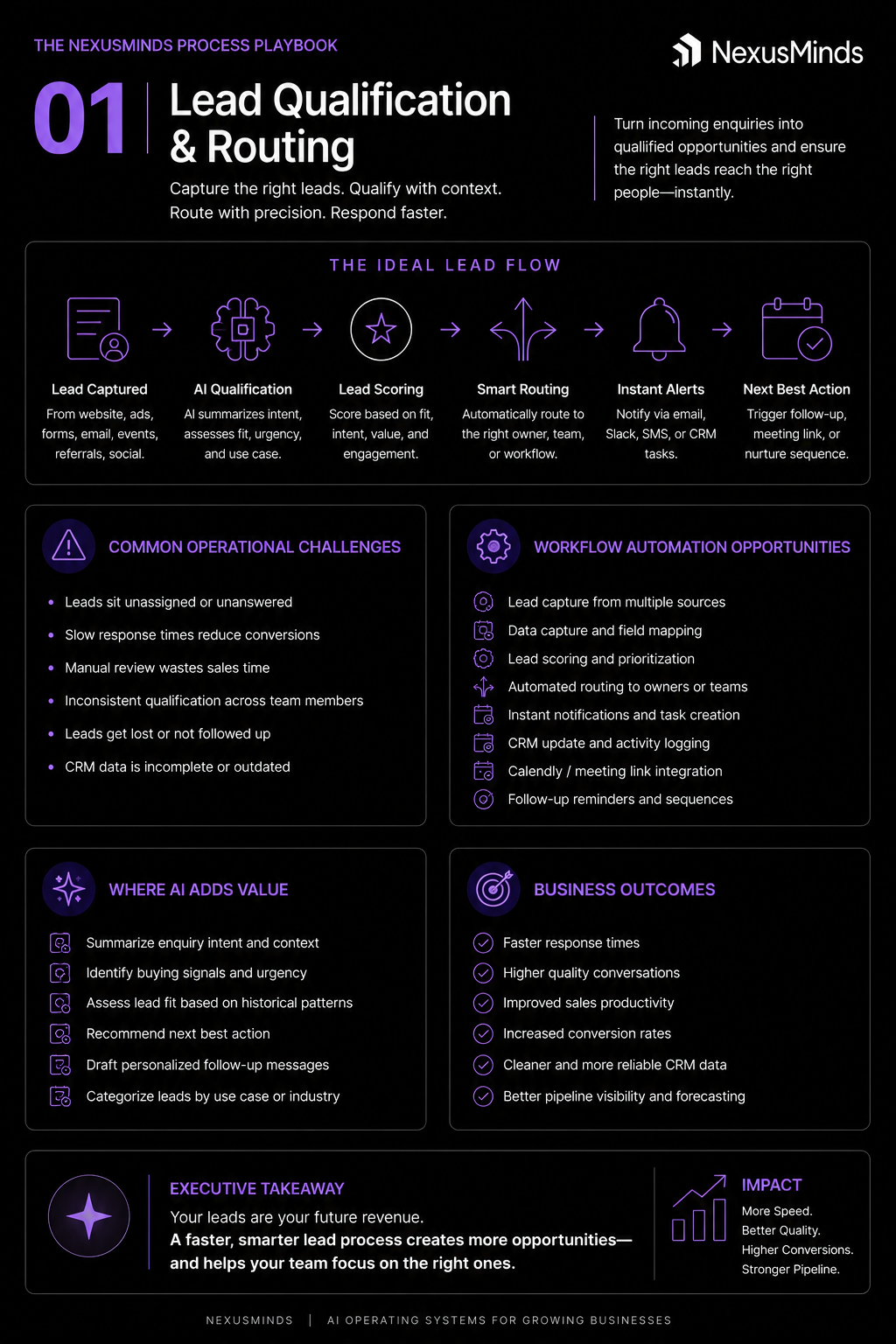
Instead of treating every lead equally, mature organizations build structured qualification workflows.
- Information is captured once.
- Business rules determine routing.
- AI assists with qualification and summarization.
- Priority is assigned automatically.
- Sales teams receive context before engaging with the prospect.
- People spend less time organizing work and more time building relationships.
Executive Takeaway
Sales teams should spend their time speaking with customers—not organizing leads.
The organizations that respond fastest with the best context often win before competitors even begin the conversation.
Business Process 2
Customer Onboarding
The customer journey doesn’t begin when a contract is signed.
It begins when implementation starts.
Unfortunately, onboarding remains one of the most fragmented operational processes in many organizations.
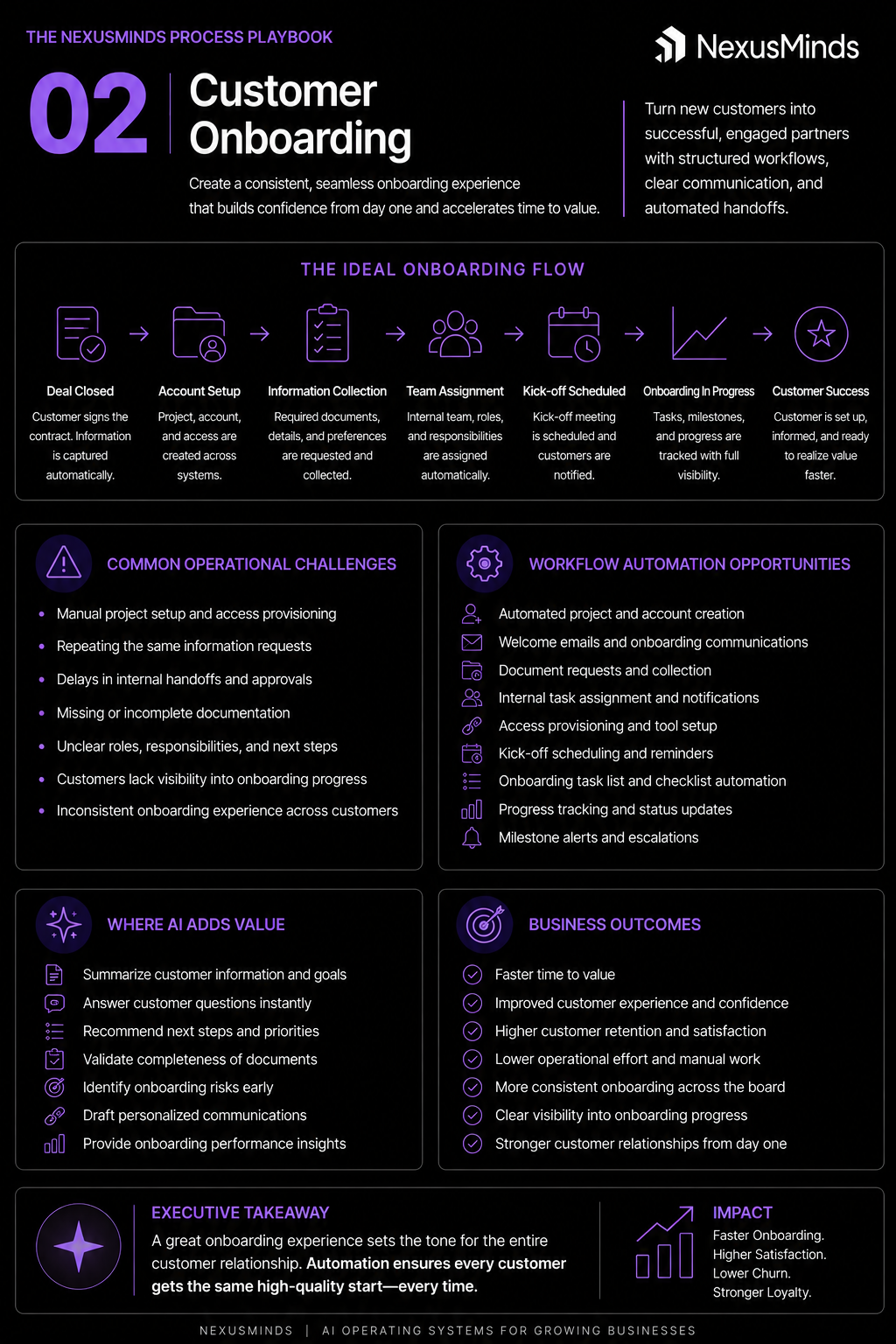
- Information collected during sales must be transferred to delivery.
- Projects must be created.
- Teams assigned.
- Access provisioned.
- Documents shared.
- Kick-off meetings scheduled.
- Progress tracked.
When these activities rely on manual coordination, delays accumulate quickly.
- Manual project setup
- Repeated customer information requests
- Delayed onboarding
- Missing documentation
- Inconsistent handovers
- Limited customer visibility
Poor onboarding creates unnecessary effort for both customers and internal teams.
- Projects start slowly.
- Questions repeat.
- Expectations become unclear.
- Customer confidence declines before value has been delivered.
Executive Takeaway
A great onboarding process creates confidence.
Automation ensures every customer receives the same high-quality experience.
Business Process 3
Proposal & Document Generation
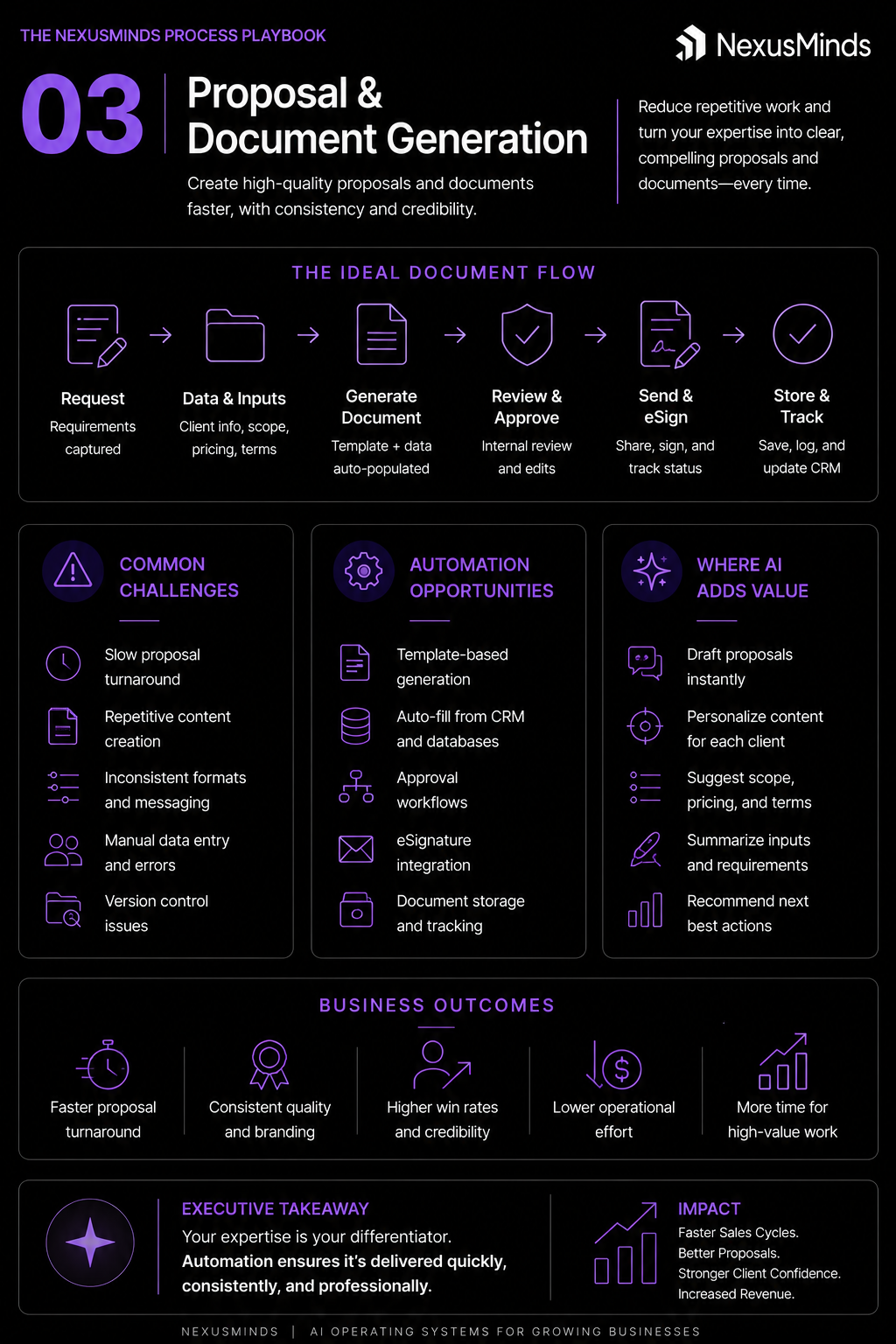
Many organizations recreate similar documents every day.
- Proposals.
- Statements of work.
- Contracts.
- Reports.
- Meeting summaries.
- Project updates.
While each document may require customization, much of the underlying structure remains consistent.
Executive Takeaway
Your experts should spend their time solving client problems—not formatting documents.
Business Process 4
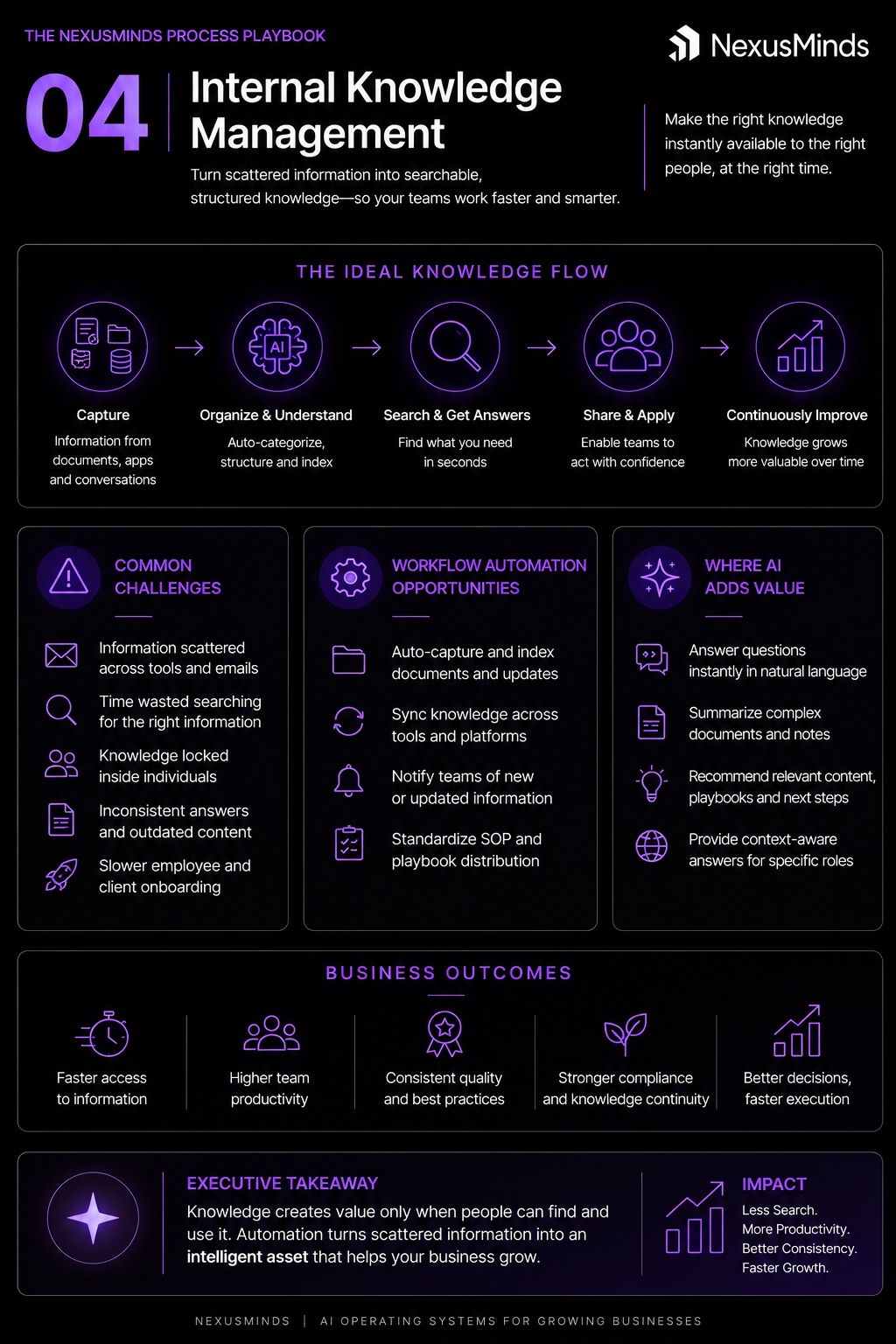
Internal Knowledge Management
As organizations grow, information becomes fragmented.
Policies live in one application.
Procedures in another.
Project knowledge inside email threads.
Customer information inside CRMs.
Employees spend significant time searching rather than executing.
Executive Takeaway
Knowledge only creates value when people can find it.
Business Process 5
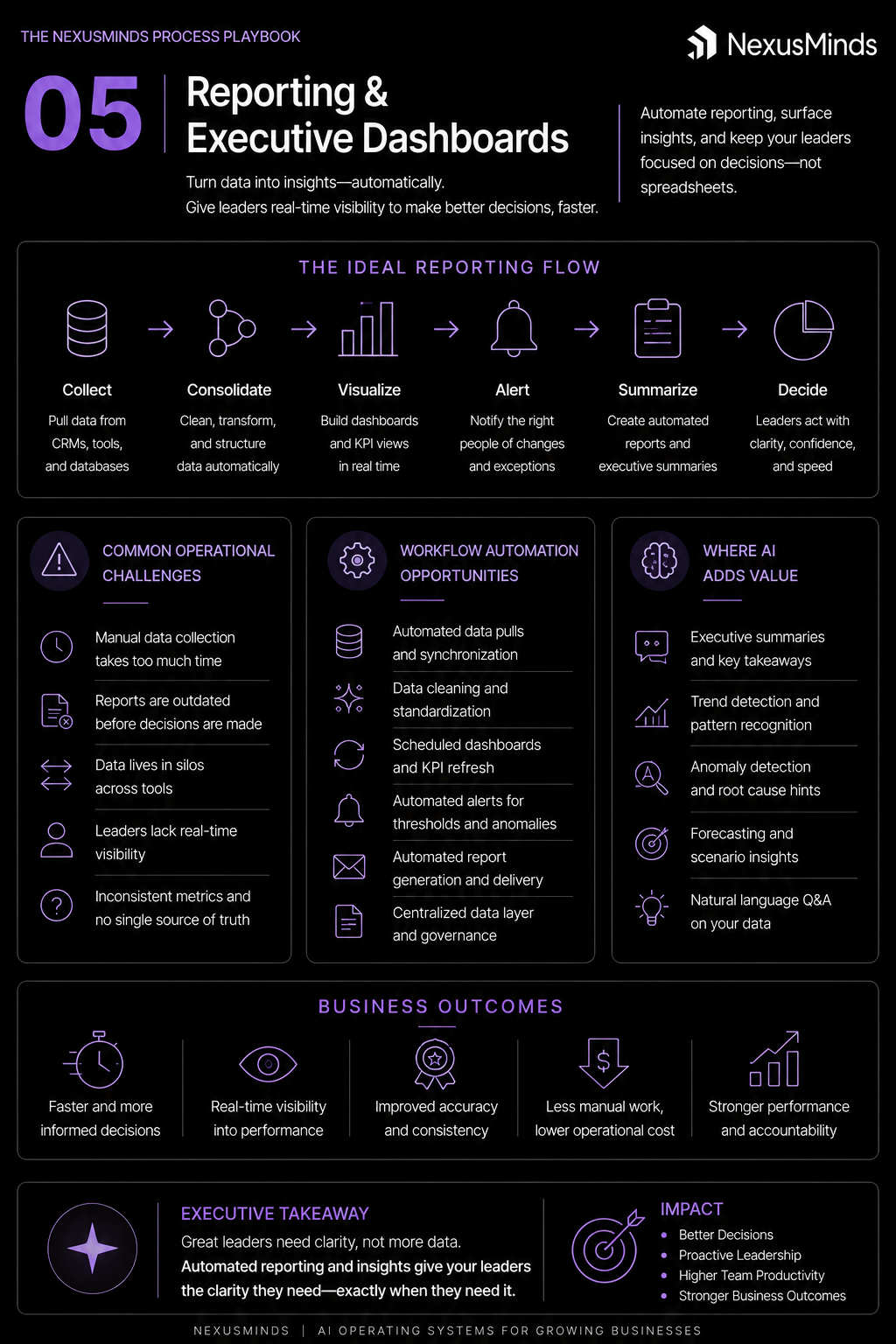
Reporting & Executive Dashboards
Leaders make decisions based on information.
Unfortunately, much of that information is assembled manually.
Teams export spreadsheets.
Combine reports.
Create presentations.
Verify numbers.
Repeat the process every week.
Executive Takeaway
Knowledge only creates value when people can find it.
Business Process 6
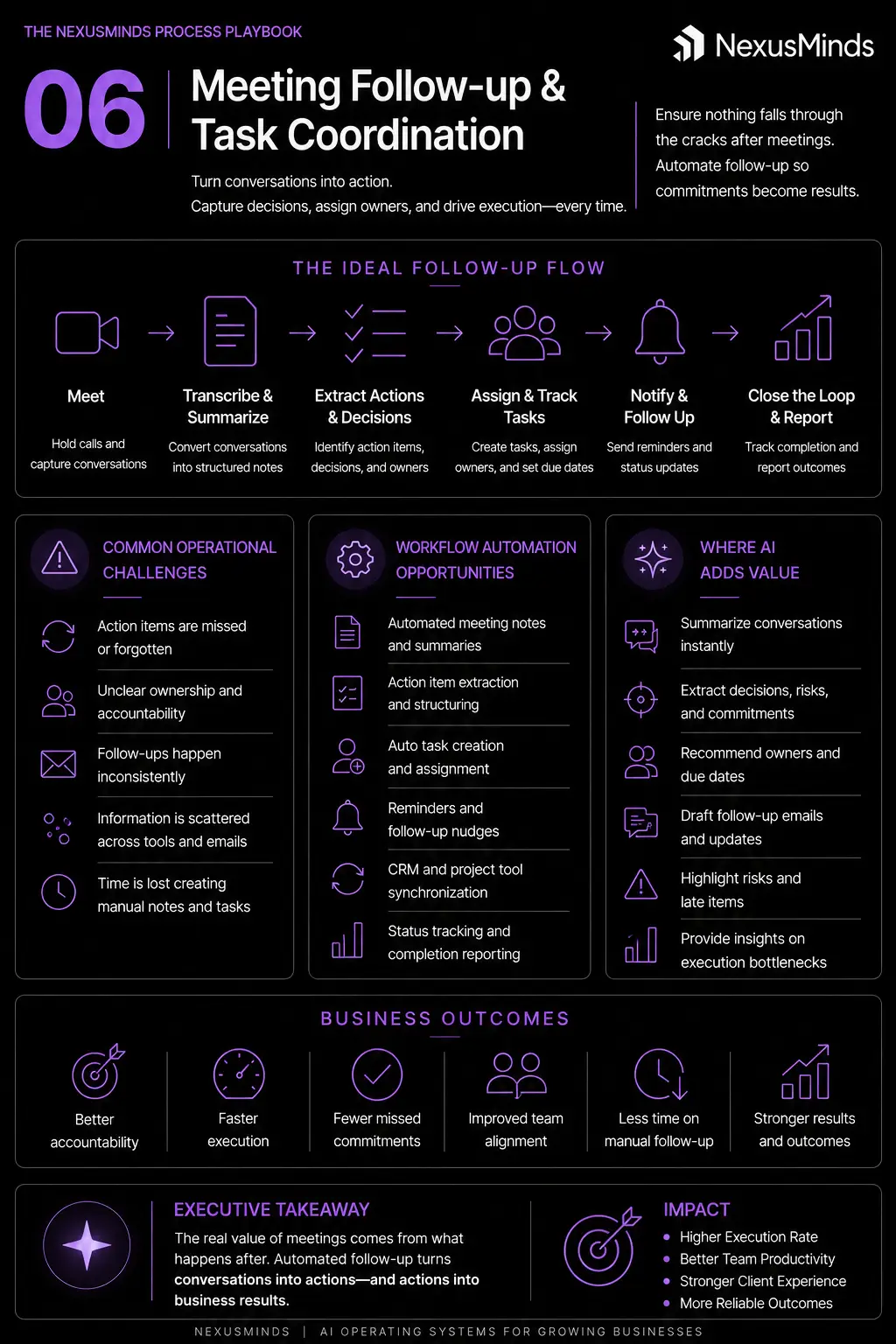
Meeting Follow-up & Task Coordination
Organizations hold hundreds of meetings.
The real challenge begins afterward.
Who owns each action?
What decisions were made?
Which commitments require follow-up?
Without structured workflows, valuable decisions disappear into meeting notes.
Executive Takeaway
Meetings should create momentum—not administrative work.
Business Process 7
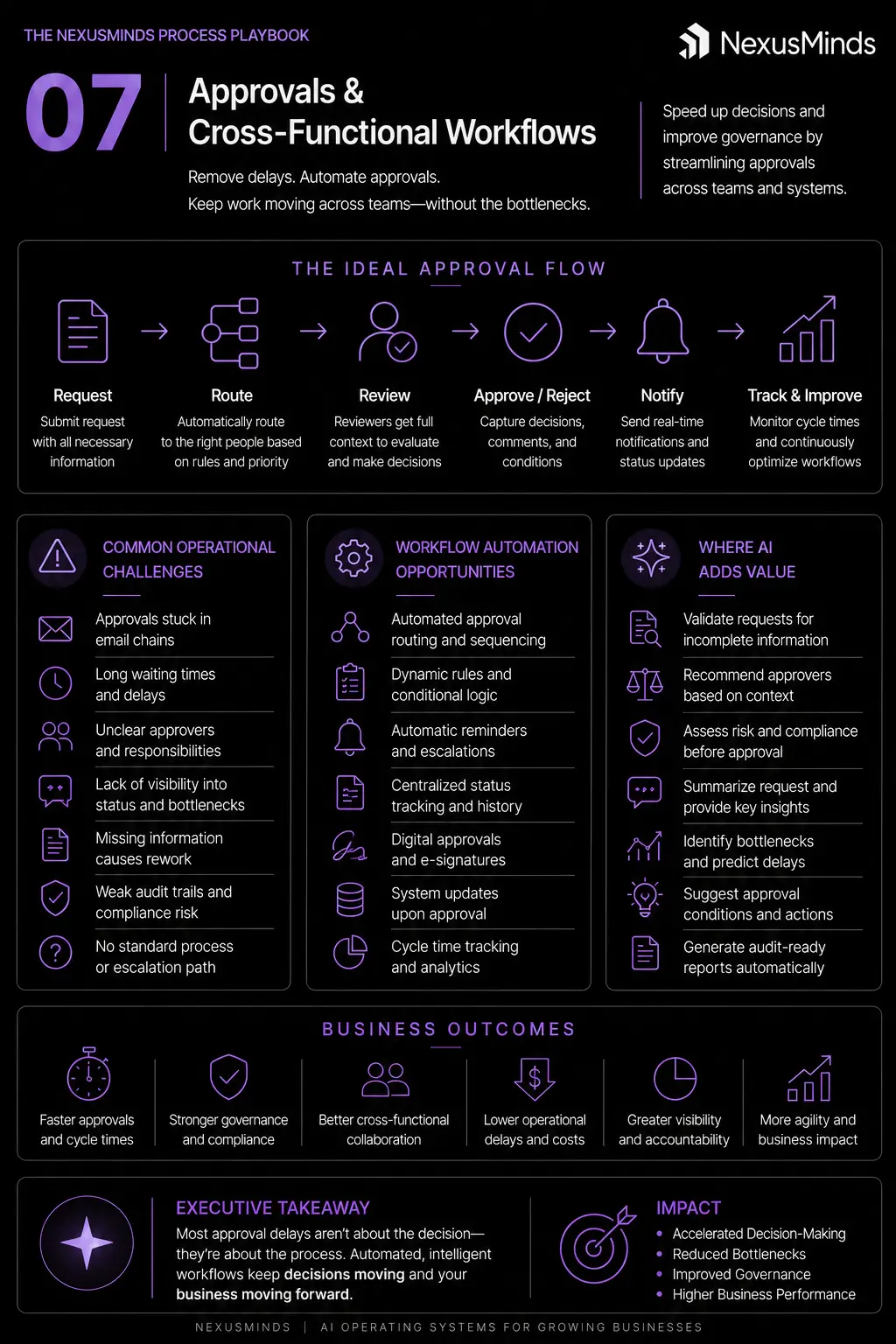
Approvals & Cross-Functional Workflows
Approval delays rarely occur because decisions are difficult.
They occur because work waits.
Waiting for emails.
Waiting for signatures.
Waiting for information.
Waiting for the next department.
As organizations grow, these delays compound.
Executive Takeaway
The speed of your business is often determined by the speed of your approvals.
Business Processes Evaluation Closing Note..
Across every organization, these seven processes have one thing in common.
- They don’t create competitive advantage because they are manual.
- They create competitive advantage when they are designed intentionally.
- Organizations that scale successfully do not automate everything.
They identify the operational capabilities that consume the most time, introduce the most friction, or create the greatest business risk—and improve those first.
That is where automation delivers its greatest return.
The Opportunity Isn’t More Automation
Throughout this guide, we’ve explored seven business processes that consistently create operational bottlenecks as organizations grow.
While every organization is different, these processes share one common characteristic:
They consume significant time, require repetitive effort, and often rely on manual coordination between people, systems, and information.
For many businesses, these operational inefficiencies become the hidden reason behind additional hiring.
Not because teams lack capability.
But because existing workflows no longer scale.
The organizations that grow most effectively don’t simply increase headcount.
They continually improve how work moves across the business.
Automation, when applied thoughtfully, becomes an enabler of that improvement—not the objective itself.
The Seven Business Processes at a Glance
The following capabilities consistently deliver the highest operational leverage across growing organizations.
Business Process | Primary Business Outcome |
Lead Qualification & Routing | Faster response times and improved sales productivity |
Customer Onboarding | Consistent implementation and stronger customer experience |
Proposal & Document Generation | Reduced administrative effort and faster sales cycles |
Internal Knowledge Management | Faster access to information and improved employee productivity |
Reporting & Executive Dashboards | Better visibility and faster decision-making |
Meeting Follow-up & Task Coordination | Improved accountability and execution |
Approvals & Cross-Functional Workflows | Reduced delays and stronger operational governance |
Every organization will prioritize these differently.
The important question is not whether to improve them.
The question is which one will create the greatest business impact first.
Continue Your Executive Learning Journey
Understanding which processes to improve is only the first step.
The next challenge is deciding:
- Which opportunities deserve attention first?
- Where will AI create measurable business value?
- Which initiatives should be prioritized?
- How do you build a practical roadmap without trying to automate everything?
These questions are explored in our companion publication:
Executive Guide 001
Inside you'll learn how to:
- Identify operational friction across your organization
- Evaluate AI opportunities using the NexusMinds Opportunity Framework™
- Prioritize initiatives with the NexusMinds AI Prioritization Matrix™
- Build an AI roadmap focused on measurable business outcomes
Own problems end-to-end — from workflow to deployment.
Ready to Scale More Intelligently?
Every organization eventually reaches a point where improving how work gets done creates greater value than simply adding more people.
At NexusMinds, we help organizations redesign operational workflows, identify high-impact automation opportunities, and implement practical AI solutions that improve execution, increase visibility, and strengthen long-term operating capacity.
Build better workflows. Increase operating capacity. Scale with confidence.
I look forward to seeing how these developments will improve service levels and customer satisfaction in the freight industry!