

Executive Guide 001: A Practical Guide to Finding High-Impact AI Opportunities in Your Business
Most organizations don't have a shortage of AI ideas—they have a shortage of clarity about where AI will create measurable business value.
After speaking with hundreds of business leaders, one pattern continues to emerge. Companies invest in AI tools before identifying the operational problems worth solving. The result is scattered pilots, disconnected initiatives, and little measurable return.
This guide introduces the same thinking we use at NexusMinds to help organizations identify where AI and automation can deliver the greatest operational impact.
Executive Summary
Most AI initiatives don’t fail because of the technology.
They fail because businesses begin with tools instead of business outcomes.
The organizations seeing meaningful returns from AI aren’t trying to automate everything. They’re identifying high-friction workflows, improving data quality, connecting systems, and applying AI where human judgment creates the greatest value.
In this guide you’ll learn:
- Why many AI initiatives struggle to deliver ROI
- How to identify high-impact automation opportunities
- A practical framework for evaluating AI use cases
- Where AI creates the most business value today
- Common mistakes to avoid before investing
"AI should never be the starting point. Business friction should."
NexusMinds Perspective Tweet
Why Most AI Initiatives Struggle
Over the past two years, organizations have invested heavily in generative AI, copilots, workflow automation platforms, and AI assistants. While awareness has increased dramatically, business outcomes have often failed to keep pace.
The challenge isn’t a lack of technology.
It’s a lack of prioritization.
Many organizations begin by asking:
“Where can we use AI?”
Unfortunately, that’s the wrong question.
It encourages teams to search for places to insert AI rather than understand how work actually flows across the business.
Successful organizations ask a different question.
“Where are our teams repeatedly losing time, context, or decision quality?”
That subtle shift changes everything.
Instead of chasing technology trends, the focus moves to solving operational problems that already exist.
When AI is introduced to improve those processes—not simply automate tasks—it becomes significantly easier to measure business value, gain user adoption, and scale successfully.
Stop Looking for AI Use Cases
One of the biggest misconceptions about AI strategy is that businesses need to search for AI use cases.
In reality, high-impact AI opportunities already exist inside almost every organization.
They appear wherever employees spend time on repetitive work, manually gather information, transfer knowledge between systems, or make similar decisions over and over again.
Rather than asking:
“Where can we implement AI?”
Start asking:
- Which activities consume the most employee time?
- Which workflows repeatedly slow down operations?
- Where do teams manually move information between systems?
- Which customer interactions follow similar patterns every day?
- Where do managers spend significant time reviewing, validating, or approving work?
These questions reveal operational friction.
Operational friction reveals automation opportunities.
The Nexus Opportunity Framework™
At NexusMinds, we evaluate AI opportunities through four operational signals.
Rather than beginning with technology, we begin by understanding how work moves through the organization.
The stronger these signals appear within a workflow, the greater the potential business impact.
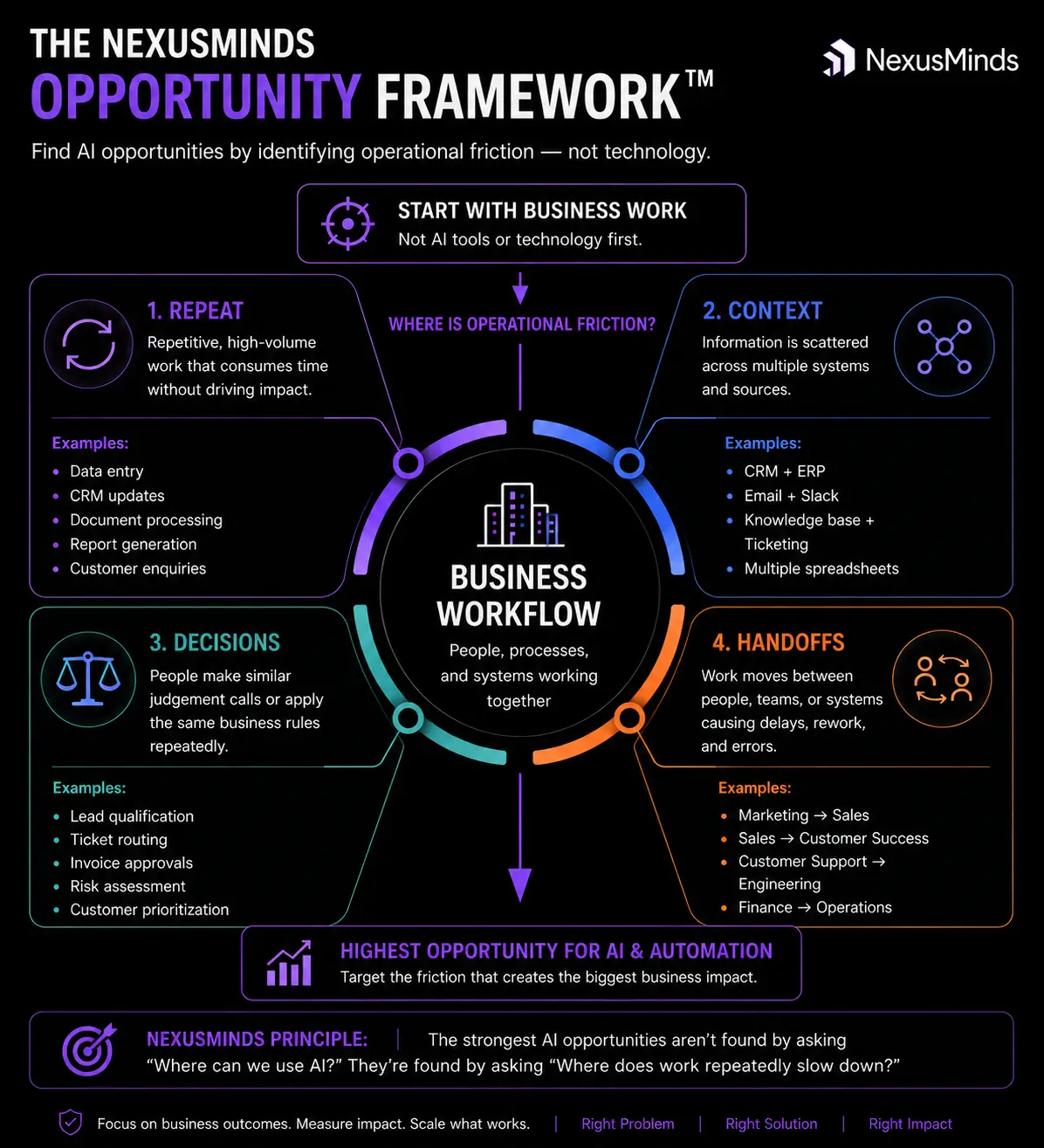
Every business workflow can be evaluated through four operational signals.
1. Repeat
Does this activity happen hundreds or thousands of times every month?
Examples:
- Data entry
- CRM updates
- Document processing
- Reporting
- Customer enquiries
The more repetitive the work, the greater the automation potential.
2. Context
Do employees spend time collecting information from multiple systems before they can complete their work?
Examples:
- CRM + ERP
- Email + Slack
- Knowledge Base + Ticketing
- Multiple spreadsheets
When people become the integration layer, AI and automation create significant efficiency gains.
3. Decisions
Does someone repeatedly apply the same business rules or make similar decisions?
Examples:
- Lead qualification
- Ticket routing
- Invoice approvals
- Risk assessment
- Customer prioritization
AI creates value by accelerating consistent decision-making—not replacing human expertise.
4. Handoffs
Does work frequently move between teams, systems, or departments?
Examples:
- Marketing → Sales
- Sales → Customer Success
- Customer Support → Engineering
- Finance → Operations
Every handoff introduces delay, duplication, and opportunities for error.
The strongest AI opportunities aren't found by asking "Where can we use AI?" They're found by asking "Where does work repeatedly slow down?"
NexusMinds Perspective Tweet
Evaluate Before You Automate
One of the most common reasons AI initiatives fail is that organizations evaluate technology before they evaluate the business process.
When a workflow is inefficient, disconnected, or poorly understood, introducing AI rarely solves the underlying problem. It often accelerates inefficiency rather than eliminating it.
Before investing in any AI initiative, business leaders should ask a different set of questions.
Not “Can AI do this?”
But rather:
“Should AI be applied here, and will it create measurable business value?”
This distinction is fundamental.
At NexusMinds, we assess every opportunity through five business lenses before recommending automation or AI.
The NexusMinds AI Prioritization Matrix™
The highest-performing organizations prioritize initiatives that deliver meaningful business outcomes while remaining practical to implement.
The NexusMinds AI Prioritization Matrix™ provides a structured way to evaluate every opportunity before committing time, budget, or technology.
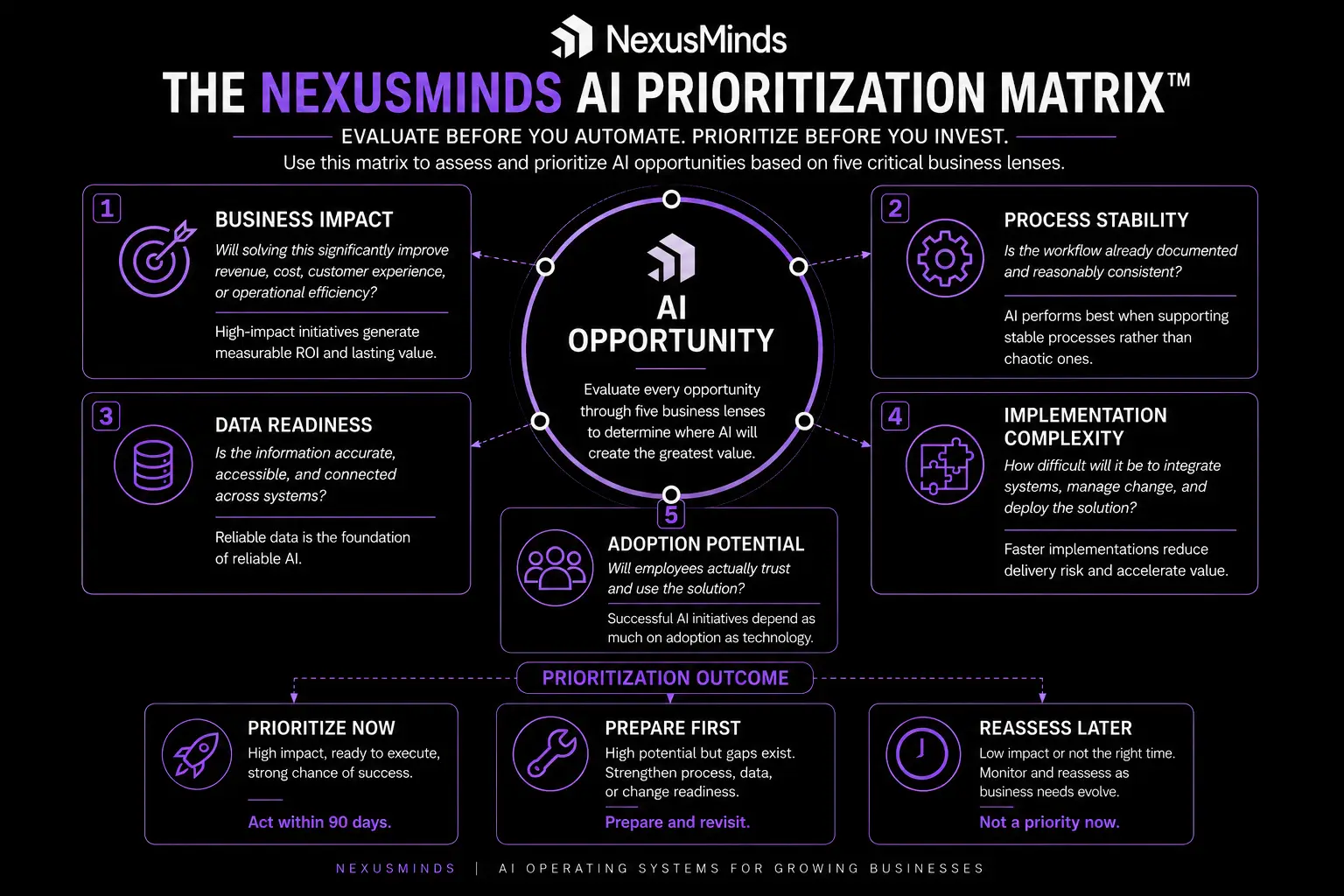
From Opportunity to Priority
After evaluating a workflow, it becomes easier to determine whether it should be addressed now, later, or not at all.
High-priority initiatives typically share several characteristics:
- They affect multiple teams or business functions.
- They occur frequently enough to create measurable inefficiencies.
- They rely on information that already exists within the organization.
- They require consistent decision-making rather than highly subjective judgment.
- They support strategic business objectives such as revenue growth, customer experience, operational efficiency, or risk reduction.
By contrast, low-priority initiatives often involve isolated tasks, infrequent activities, or processes that remain poorly defined.
Automating these workflows may save a few minutes here and there, but rarely changes how the business performs.
A Better Question Than "Where Can We Use AI?"
One of the simplest ways to improve AI decision-making is to replace one question with another.
Instead of asking… | Ask this instead… |
Where can we use AI? | Where is work repeatedly slowing down? |
Which AI tool should we buy? | Which business outcome are we trying to improve? |
How much can we automate? | Which activities create the greatest operational friction? |
Can AI replace people? | How can AI augment our teams and improve decision-making? |
Which department should start? | Which workflow will deliver measurable impact within the next 90 days? |
This shift changes AI from a technology initiative into a business transformation initiative.
"The best AI projects aren't the most technically impressive—they're the ones employees adopt and the business can measure."
NexusMinds Perspective Tweet
The Goal Isn't More AI
Organizations often measure AI success by the number of copilots deployed, automations built, or licenses purchased.
These are activity metrics.
Business leaders should focus on outcome metrics instead.
Examples include:
- Faster customer response times
- Reduced manual effort
- Shorter sales cycles
- Higher employee productivity
- Improved data quality
- Better decision consistency
- Increased customer retention
- Lower operational costs
AI should improve how the business operates—not simply increase the amount of technology in use.
Where AI Creates the Greatest Business Value Today
By this stage, you’ve identified operational friction and evaluated which opportunities deserve attention.
The next question is often the most important:
Where should we start?
Many organizations assume AI delivers the greatest value in the most complex parts of the business.
In practice, the opposite is often true.
The strongest returns usually come from improving the everyday workflows that employees repeat hundreds of times each week—capturing information, making decisions, moving work between teams, and generating business insight.
Rather than thinking in terms of AI tools, leading organizations think in terms of business capabilities.
They ask:
Which capability, if improved, would create the greatest impact across the business?
The NexusMinds AI Value Map™
Every organization is different, but most high-impact AI initiatives fall into five business capability areas.
These capabilities consistently create measurable improvements in productivity, operational efficiency, customer experience, and decision quality.
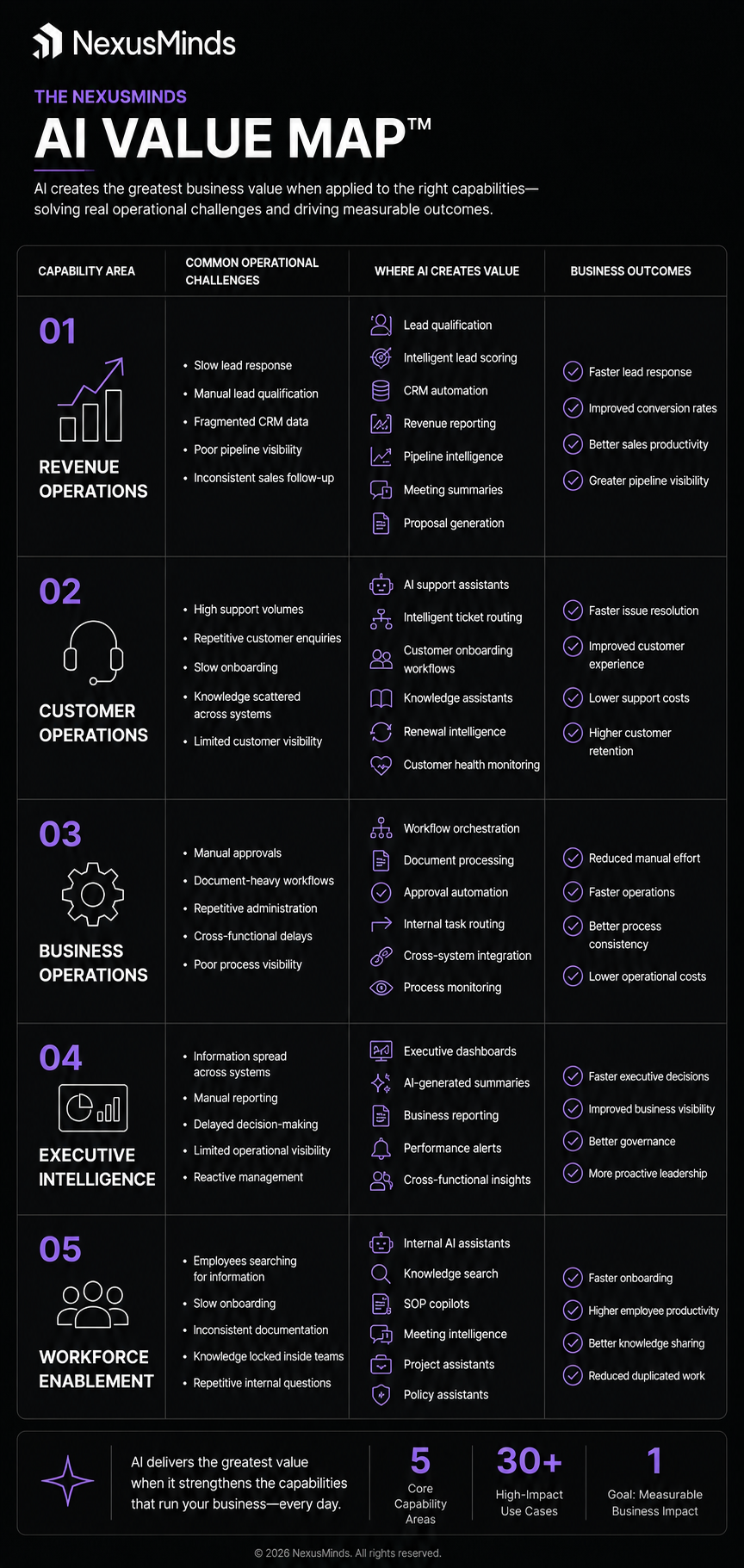
An Important Observation
One of the biggest misconceptions about AI is that organizations should begin with the most technically ambitious projects.
Experience suggests otherwise.
The strongest initiatives usually improve business capabilities that already matter to the organization—revenue generation, customer service, operational efficiency, executive decision-making, and workforce productivity.
Technology is simply the enabler.
The business capability is the investment.
The First 90 Days
Organizations that achieve sustainable AI adoption rarely launch dozens of initiatives simultaneously.
Instead, they build confidence through measurable progress.
Days 1–30 — Understand
Focus on understanding how work currently flows through the business.
- Map key workflows.
- Identify operational friction.
- Assess systems and data quality.
- Prioritize opportunities using the NexusMinds Opportunity Framework™ and AI Prioritization Matrix™.
Primary Goal
Create clarity before introducing technology.
Days 31–60 — Improve
Select one high-impact workflow.
Design, implement, and validate an AI-assisted solution.
Measure business outcomes rather than technical activity.
Focus on:
- User adoption
- Workflow reliability
- Business performance
- Governance
Primary Goal
Prove measurable business value.
Days 61–90 — Scale
Expand from one successful workflow into adjacent business capabilities.
Standardize:
- Governance
- Documentation
- Reporting
- Ownership
- Continuous improvement
The objective is not to deploy more AI.
It is to build a more intelligent operating model.
Final Thoughts
The organizations creating the greatest value from AI are not necessarily those deploying the newest tools.
They’re the ones improving how work moves across the business.
They understand that AI is only one component of operational excellence.
The real advantage comes from connecting people, processes, systems, and data into workflows that are easier to execute, easier to manage, and easier to improve.
That’s why the most successful AI initiatives don’t begin with technology.
They begin with understanding the business.
Ready to Identify Your Highest-Impact AI Opportunities?
Every organization has opportunities to improve productivity, reduce operational friction, and make better decisions.
The challenge isn’t finding opportunities.
It’s knowing which ones are worth pursuing first.
At NexusMinds, we help organizations identify, prioritize, and implement AI and workflow automation initiatives that deliver measurable business outcomes—not just technical deployments.
Start with the right business problem. Build the right operating capability. Let technology follow.
I look forward to seeing how these developments will improve service levels and customer satisfaction in the freight industry!