

Agentic AI vs Traditional Automation: What Business Leaders Need to Know
Executive Summary
Agentic AI vs traditional automation is no longer a technology discussion—it is a business strategy decision. Traditional automation excels at executing predefined rules, while Agentic AI combines reasoning, planning and autonomous decision-making to orchestrate complex business workflows. The most successful organisations will not replace automation with AI; they will combine both within governed AI Operating Systems.
Key Takeaways
- Traditional automation remains the most effective solution for repetitive, rules-based work.
- Agentic AI enables workflows to reason, adapt and make bounded decisions.
- Most organisations should evolve through stages rather than replacing existing automation.
- Governance, human oversight and observability are essential for enterprise AI adoption.
- The future belongs to organisations that design AI Operating Systems—not disconnected AI tools.
What Is Agentic AI?
Agentic AI refers to artificial intelligence systems that can pursue goals rather than simply respond to prompts. Unlike conventional AI assistants that generate text or answer questions, AI agents can plan, reason, use external tools, retrieve information, execute tasks and determine the next best action within defined business constraints.
For enterprise leaders, the distinction is important.
Instead of asking AI to generate work, organisations increasingly expect AI to complete work.
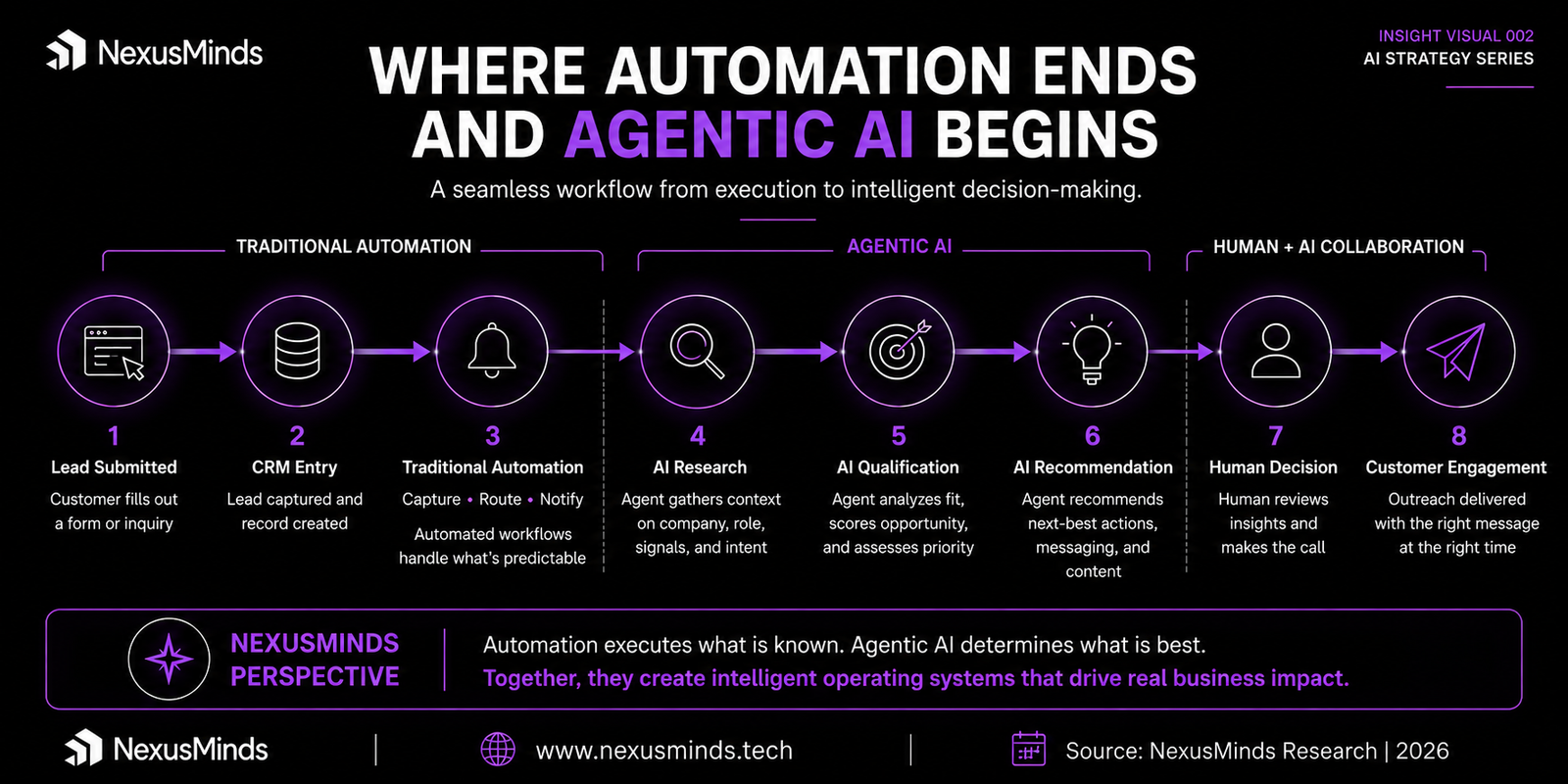
For example, rather than drafting a sales email, an AI agent can research a prospect, enrich company data, qualify the opportunity, prepare personalised messaging, update the CRM and request approval before sending—all within a governed workflow.
What Is Traditional Automation?
Traditional automation refers to software that executes predefined workflows using deterministic rules.
Business Process Automation (BPA), Robotic Process Automation (RPA), workflow engines and integration platforms have transformed operations by automating repetitive, predictable tasks such as invoice routing, CRM updates, approvals and notifications.
These systems are exceptionally reliable because every decision has already been defined.
However, they cannot interpret ambiguity, understand context or adapt when business situations change unexpectedly.
Agentic AI vs Traditional Automation: Key Differences
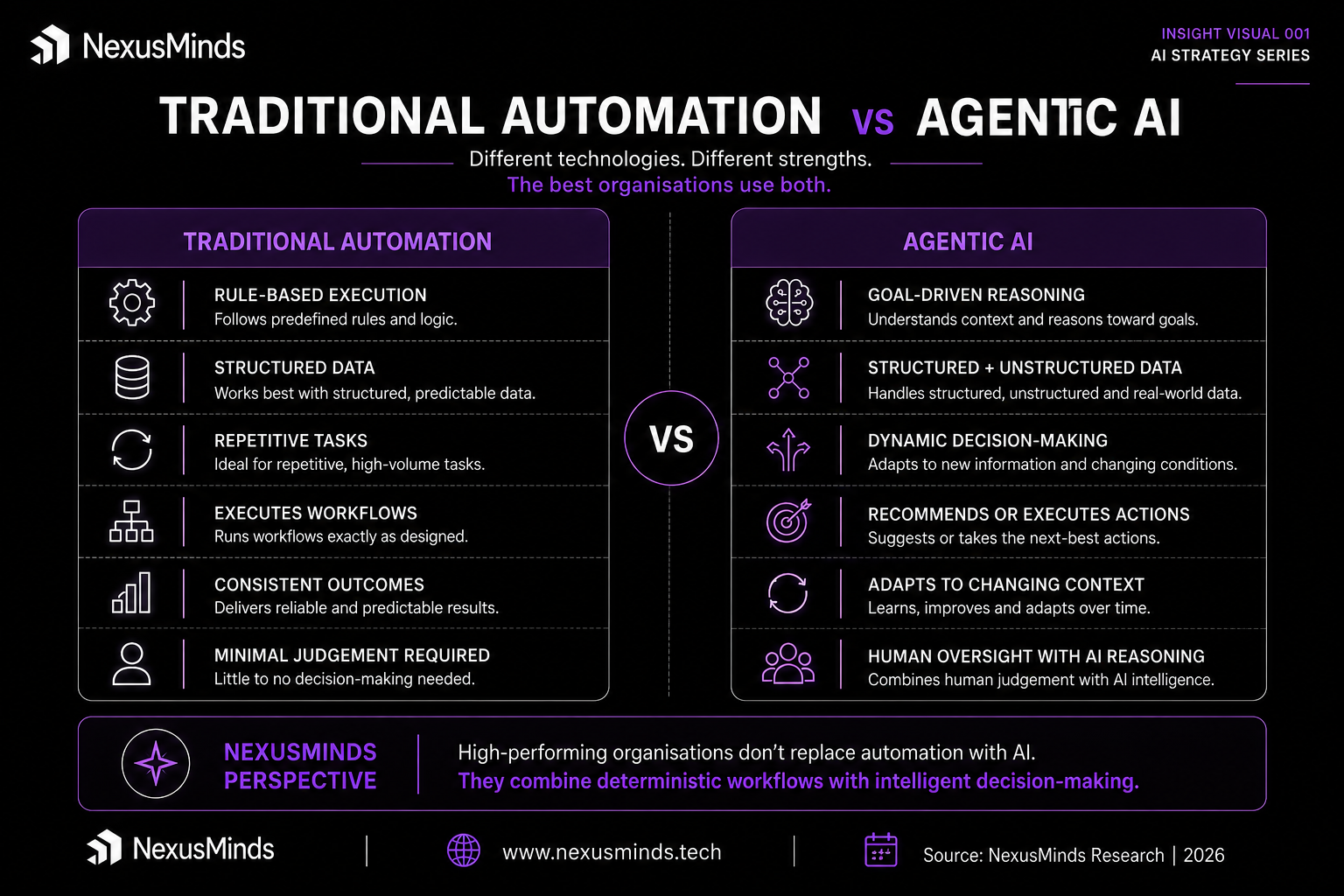
Think of traditional automation as an exceptionally reliable operations specialist that follows instructions precisely.
Agentic AI behaves more like an experienced analyst—evaluating information, weighing alternatives and selecting the most appropriate next step before acting.
Neither replaces the other. They solve different business problems.
Traditional Automation
Agentic AI
Rule-based execution
Goal-oriented execution
Fixed workflows
Adaptive workflows
Structured data
Structured and unstructured data
Predefined business logic
AI reasoning + business rules
Stops at exceptions
Investigates, adapts or escalates
Limited context
Context-aware decision making
Task automation
Workflow orchestration
Predictable outcomes
Dynamic outcomes within governance
Human designs every step
AI determines intermediate steps
Best for repetitive work
Best for knowledge work
Traditional Automation | Agentic AI |
Rule-based execution | Goal-oriented execution |
Fixed workflows | Adaptive workflows |
Structured data | Structured and unstructured data |
Predefined business logic | AI reasoning + business rules |
Stops at exceptions | Investigates, adapts or escalates |
Limited context | Context-aware decision making |
Task automation | Workflow orchestration |
Predictable outcomes | Dynamic outcomes within governance |
Human designs every step | AI determines intermediate steps |
Best for repetitive work | Best for knowledge work |
"Traditional automation executes instructions. Agentic AI pursues objectives."
When Should Businesses Use Traditional Automation?
Traditional automation remains the preferred approach whenever the process is predictable, repetitive and governed by fixed business rules.
Examples include:
- Invoice approvals
- Employee onboarding
- CRM synchronisation
- Calendar scheduling
- Status notifications
- ERP integrations
- Compliance reporting
If the correct answer is already known before the workflow starts, deterministic automation is usually the most efficient and reliable solution.
When Should Businesses Use Agentic AI?
Agentic AI creates value when workflows require reasoning rather than repetition.
Typical enterprise use cases include:
- Lead qualification
- Competitive intelligence
- Customer support triage
- Proposal generation
- Knowledge management
- Executive reporting
- Vendor research
- Contract analysis
These workflows require interpreting information, making contextual decisions and adapting to new inputs—capabilities that traditional automation cannot provide on its own.
The Enterprise Evolution Toward AI Operating Systems
One of the biggest misconceptions surrounding Agentic AI is that businesses should replace their existing automation platforms.
In reality, enterprise AI maturity develops progressively.
Stage 1. Rules-Based Automation
Organisations automate repetitive, deterministic tasks using workflow platforms and business rules.
Stage 2. AI-Assisted Workflows
AI supports employees by summarising information, generating content, analysing documents and improving individual productivity.
Stage 3. Agentic Workflows
AI agents coordinate multiple business activities, use external tools, retrieve information and recommend actions while humans supervise important decisions.
Stage 4. Governed AI Operating Systems
Multiple AI agents collaborate across departments within clearly defined governance boundaries, combining deterministic workflows, AI reasoning and human oversight into an integrated business operating model.
This progression represents the future of enterprise AI, not isolated AI assistants, but connected AI Operating Systems.
Which Approach Is Right for Your Business?
Rather than asking whether Agentic AI is better than traditional automation, business leaders should ask which approach best fits each workflow.
Business Scenario | Recommended Approach |
Repetitive operational tasks | Traditional Automation |
Fixed approval workflows | Traditional Automation |
Data synchronisation | Traditional Automation |
Research and analysis | Agentic AI |
Customer enquiries | Agentic AI |
Sales qualification | Agentic AI |
Executive decision support | Agentic AI |
Cross-functional workflow orchestration | Agentic AI + Automation |
The highest-performing organisations combine both approaches rather than treating them as competing technologies.
The Role of Governance
As AI agents gain access to enterprise systems, governance becomes a business capability rather than simply a compliance requirement.
Business leaders should define:
- What agents are authorised to do
- Which systems and data they may access
- When human approval is required
- How actions are logged and monitored
- How exceptions are escalated
- How workflows are continuously improved
Governance enables organisations to scale AI confidently while maintaining transparency, accountability and operational control.
NexusMinds Perspective
Traditional automation is not becoming obsolete.
It is becoming the operational foundation upon which Agentic AI is built.
The organisations creating the greatest business value are not replacing deterministic workflows—they are extending them with AI reasoning, human oversight and intelligent orchestration.
The future belongs to businesses that stop thinking about individual AI tools and begin designing AI Operating Systems that connect people, processes, data and intelligent agents into a single governed operating model.
Frequently Asked Questions
Can Agentic AI replace traditional automation?
No. Traditional automation remains the most effective solution for predictable, rules-based processes. Agentic AI complements automation by adding reasoning and adaptability where human judgement is required.
Is Agentic AI the same as AI agents?
AI agents are the building blocks of Agentic AI. Agentic AI refers to the broader capability of autonomous, goal-oriented systems that coordinate one or more AI agents within business workflows.
Does every business need Agentic AI?
No. Organisations should first automate deterministic processes before introducing Agentic AI into workflows that require interpretation, research or decision support.
What industries benefit most from Agentic AI?
Professional services, financial services, healthcare, manufacturing, technology, logistics and customer service organisations are already applying Agentic AI to improve operational efficiency and decision-making.
Conclusion
The debate is no longer Agentic AI vs traditional automation.
The real opportunity lies in understanding where each creates the greatest business value.
Traditional automation delivers consistency, speed and operational reliability. Agentic AI extends those capabilities with reasoning, adaptability and intelligent workflow orchestration.
The organisations that will lead the next decade will not simply deploy more AI. They will combine deterministic automation, Agentic AI and governance into connected AI Operating Systems that continuously improve how work is performed.
The question for business leaders is no longer whether AI should become part of the enterprise.
The question is how quickly they can redesign workflows to capture its full potential.