

AI Agent Governance: A Practical Framework for Enterprise Leaders
AI agent governance is the system of controls that determines what an agent may do, which data and tools it may access, when human approval is required, and how its actions are monitored, reversed and audited. Effective governance must be proportional to the authority delegated to each agent—not applied uniformly across every use case
AI governance changes when systems can take action
Traditional AI systems typically classify information, generate content or recommend a decision. AI agents go further. They can plan a sequence of steps, retrieve data, call software tools, update systems of record and communicate with customers, employees or suppliers.
That shift from generating an answer to executing an action changes the enterprise risk model.
An inaccurate summary may inconvenience an employee. An agent with excessive permissions could modify a customer record, disclose confidential information, approve an unsuitable transaction or trigger a workflow across several connected systems.
The adoption curve is also accelerating. Gartner forecasts that 40% of enterprise applications will include task-specific AI agents by the end of 2026, up from less than 5% in 2025. It also predicts that an average global Fortune 500 enterprise could have more than 150,000 agents in use by 2028. Yet only 13% of organisations believe they currently have the right agent-governance arrangements in place.
The governance challenge is therefore not theoretical. Enterprises may soon be managing thousands of software actors with different identities, objectives, permissions and levels of autonomy.
The hard reality of ungoverned autonomy
Gartner predicts that by 2027, 40% of enterprises will demote or decommission autonomous AI agents after governance gaps are discovered through production incidents. Its central warning is that organisations frequently treat agent governance as binary: an agent is either tightly restricted or broadly trusted. Both approaches create failure.
Over-restricting low-risk agents creates unnecessary friction and encourages teams to build outside approved environments. Under-restricting agents with broad access creates operational, security and compliance exposure.
The risk increases across three dimensions:
- Autonomy: How independently can the agent decide and act?
- Access: Which data, tools and systems can it reach?
- Impact: What is the consequence if its action is wrong?
A read-only knowledge agent operating within approved documents is not equivalent to an agent that can change pricing, send external communications or initiate payments. Applying the same controls to both is not governance; it is administrative convenience.
"Governance should follow delegated authority. An enterprise should never give an AI agent more authority than it can observe, constrain and defend."
NexusMinds perspective Tweet
Why traditional AI governance is not enough
Most enterprise AI governance programmes were designed around models: how they were trained, tested, approved and monitored.
AI agents introduce a wider system.
The model reasons, but tools execute. Memory retains context. Identity determines access. Orchestration coordinates steps. External data can influence behaviour. Other agents may participate in the same workflow.
OWASP identifies attack surfaces across agent reasoning, memory, tools, identity, human oversight and multi-agent interactions. NIST’s 2026 work on agent security similarly found broad agreement that established cybersecurity practices remain relevant but must be adapted to address the distinct risks created when model outputs are connected to software capabilities and real-world actions.
A policy stating that an agent “must not disclose confidential data” is not a control if the agent can access that data, send messages externally and operate without runtime inspection.
Responsible agentic AI therefore requires governance to be implemented inside the architecture:
- identity and authentication;
- least-privilege permissions;
- approved tools and data boundaries;
- human-approval gates;
- transaction limits;
- monitoring and logging;
- escalation and shutdown procedures;
- formal version and change control.
The NexusMinds AI Agent Governance Framework™
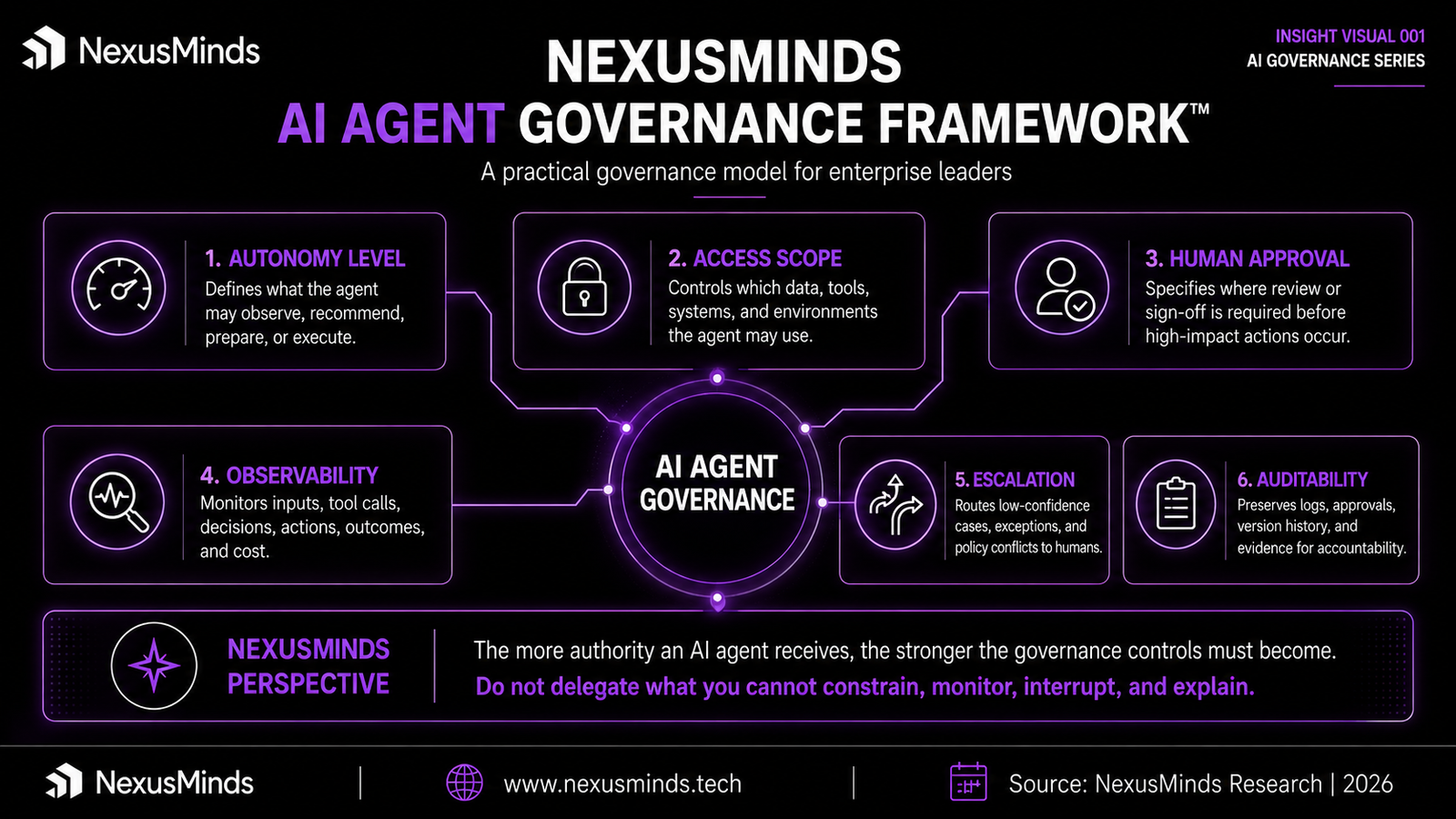
The NexusMinds framework evaluates every agent across six connected control dimensions.
1. Autonomy level
Define whether the agent may observe, recommend, prepare an action or execute independently.
Autonomy should be explicitly granted. It should never emerge accidentally because a tool integration happens to make an action technically possible.
2. Access scope
Specify the data, applications, tools and environments available to the agent.
Use a separate agent identity rather than shared employee credentials. Apply least-privilege access and separate read, write, approve and administer permissions.
3. Human approval
Identify decisions that require confirmation before execution.
Approval should be based on consequence, not inconvenience. Financial commitments, legal decisions, external communications, sensitive-data handling and irreversible system changes should normally carry stronger review requirements.
4. Observability
Capture what the agent received, what it decided, which tools it called, what actions occurred, how much the workflow cost and whether the result met expectations.
Logging only the final response is insufficient. Enterprises must be able to inspect the action path.
5. Escalation
Define what happens when the agent encounters low confidence, contradictory instructions, missing data, policy conflicts or an unfamiliar exception.
A governed agent must know when to stop. Escalation is not a weakness in the system; it is a deliberate boundary on delegated authority.
6. Auditability
Maintain evidence that allows the organisation to reconstruct an event: what happened, why it happened, which data and policies were used, who approved the action and which system version was active.
Auditability supports incident investigation, compliance, performance improvement and accountability.
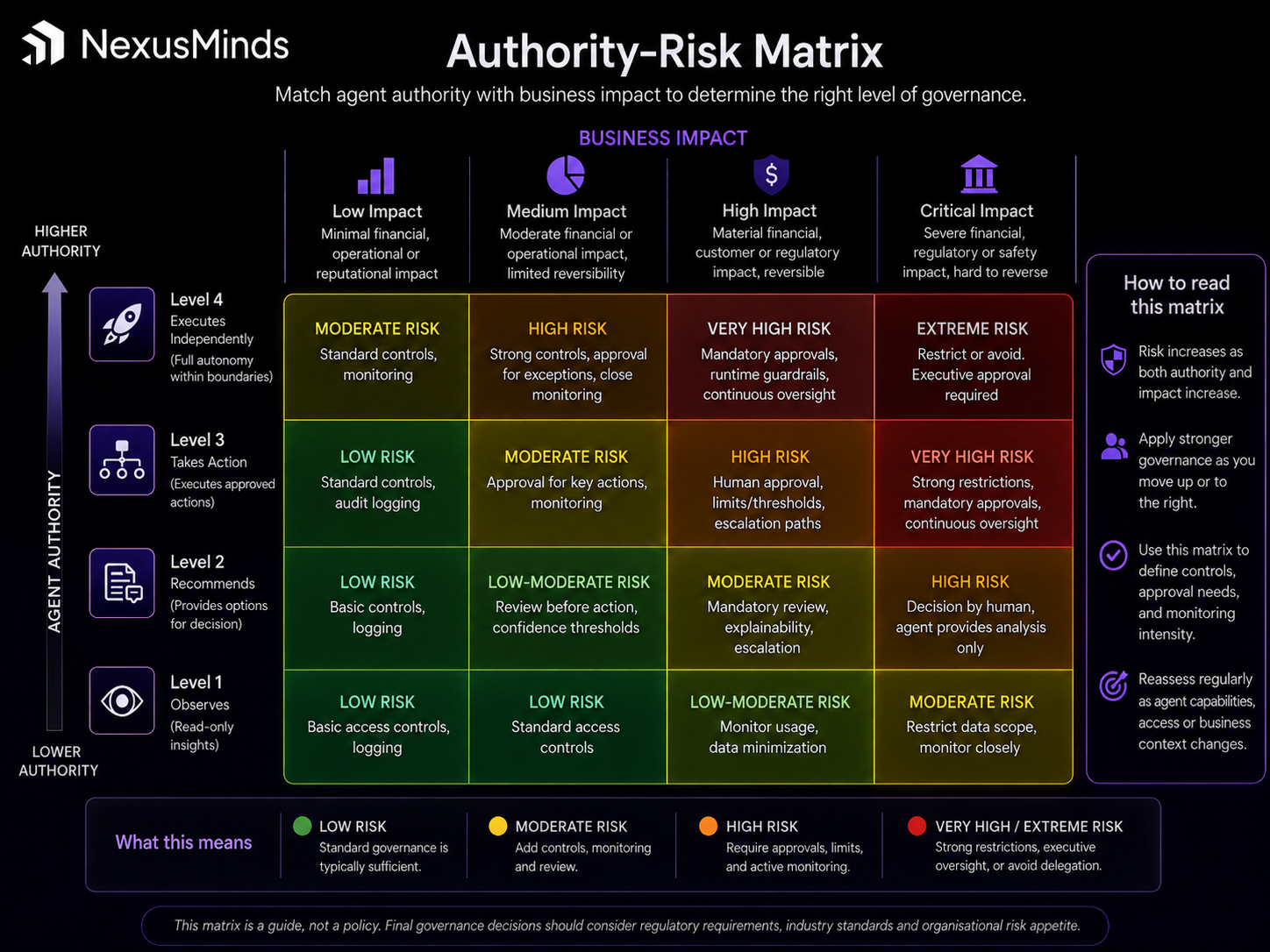
| Agent role | Typical authority | Minimum governance | |
1. Observe | Retrieve and summarise | Read approved sources | Authentication, scoped access and usage logs | |
2. Recommend | Analyse and propose | Produce recommendations | Source validation, confidence thresholds and human review | |
3. Prepare | Construct an action | Draft messages, records or transactions | Approval gates, separate identity and reversible staging | |
4. Act within boundaries | Execute approved action classes | Update systems or trigger workflows | Runtime policy checks, limits, monitoring and exception handling | |
5. Delegated operations | Pursue goals across systems | Coordinate consequential actions | Isolation, full audit trails, continuous oversight, kill switches and executive accountability |
This is not a universal industry classification. It is a practical NexusMinds model for matching governance intensity to delegated authority.
The important principle is proportionality. Governance should become stronger as autonomy, access and potential impact increase.
Runtime governance: where policy becomes operational
Pre-deployment reviews remain necessary, but they cannot anticipate every context an agent may encounter.
Runtime governance evaluates the agent while work is occurring. Depending on the use case, that may include:
- checking permissions before every tool call;
- blocking prohibited data transfers;
- restricting tools to approved allowlists;
- enforcing transaction or spending thresholds;
- requiring approval for high-impact actions;
- monitoring abnormal behaviour, latency and cost;
- limiting what may enter or remain in agent memory;
- suspending the agent when controls fail.
NIST’s AI Agent Standards Initiative is prioritising agent security, identity and authorisation because agents must function securely on behalf of users while interacting with external systems and internal data.
Prompts can guide behaviour. They should not be treated as security boundaries.
How enterprise leaders should implement AI agent governance
Begin with an inventory. Every active or planned agent should have a documented purpose, owner, autonomy level, access scope and business impact.
Then define its authority:
- List prohibited, permitted and approval-dependent actions.
- Assign separate business, technical and risk owners.
- Apply least-privilege identity and access controls.
- Establish human-review thresholds for consequential actions.
- Log decisions, tool calls, outputs, failures and costs.
- Test normal, adversarial and failure scenarios.
- Provide rollback, escalation and immediate suspension mechanisms.
- Review permissions and performance throughout the agent lifecycle.
Governance should be incorporated during workflow design—not added after an agent reaches production.
AI agent governance readiness check
Before granting production authority, leaders should be able to answer yes to these questions:
- Does every agent have a named business owner?
- Is its autonomy level explicitly classified?
- Does it use a dedicated identity?
- Is access limited to necessary data and tools?
- Are high-impact actions subject to approval?
- Can the organisation inspect its complete action path?
- Are memory and retained data governed?
- Can incorrect actions be reversed?
- Is there a documented escalation process?
- Can the agent be suspended immediately?
- Are updates tested and formally authorised?
- Are value, performance, risk and cost reviewed regularly?
Ten or more positive answers indicate a credible initial foundation. Seven to nine suggest material gaps. Fewer than seven indicate that the organisation is not ready to delegate meaningful production authority.
Frequently asked questions
What is AI agent governance?
AI agent governance defines the architectural, operational and organisational controls governing an agent’s identity, autonomy, access, actions, monitoring and accountability.
How is agent governance different from traditional AI governance?
Traditional governance often concentrates on models, data and outputs. Agent governance must additionally control tool use, permissions, memory, runtime actions, workflow dependencies and interactions with other systems or agents.
Do all AI agents require the same controls?
Traditional governance often concentrates on models, data and outputs. Agent governance must additionally control tool use, permissions, memory, runtime actions, workflow dependencies and interactions with other systems or agents.
When should an AI agent require human approval?
Human approval is appropriate when an action is financially material, legally consequential, externally visible, difficult to reverse or involves sensitive data, safety or employee and customer rights.
Who owns AI agent governance?
Ownership should be shared across business leadership, technology, security, data, risk and compliance. Every agent should also have one clearly accountable business owner.
Conclusion
AI agent governance is not about preventing autonomy. It is about making autonomy deliberate, bounded and accountable.
As agents gain access to enterprise data and authority to act across business systems, governance must move from static policy documents into identity, permissions, architecture and runtime control.
The NexusMinds AI Agent Governance Framework™—Autonomy, Access, Human Approval, Observability, Escalation and Auditability—gives enterprise leaders a practical basis for deciding how much authority an agent should receive and what must be in place before that authority is granted.
The governing principle is simple: do not delegate an action to an AI agent unless the organisation can constrain it, monitor it, interrupt it and explain it.
Governance isn't about restricting AI. It's about enabling trusted autonomy.
NexusMinds Perspective Tweet
I look forward to seeing how these developments will improve service levels and customer satisfaction in the freight industry!