

Executive Guide 003: A Practical Framework for Turning AI Ambition into Business Outcomes
Artificial Intelligence has moved beyond experimentation. For most executive teams, the question is no longer whether to adopt AI, but how to implement it successfully.
Yet despite unprecedented investment, many organizations struggle to convert AI pilots into measurable business value. Recent research indicates that while AI adoption is widespread, enterprise-wide transformation remains rare. Most organizations continue to experiment with isolated use cases rather than redesigning the workflows where AI creates the greatest value.
This guide introduces the NexusMinds AI Implementation Roadmap™—a practical five-stage framework that helps business leaders move from AI experimentation to sustainable operational impact.
In this guide, you’ll learn:
- Why AI implementation fails more often than AI technology.
- The five stages of successful enterprise AI adoption.
- How to build organizational readiness before investing in technology.
- Practical actions executives can take to increase adoption and business value.
Estimated Reading Time: 8–10 minutes
AI Isn't the Problem. Implementation Is.
Organizations across every industry are investing aggressively in AI. However, investment alone does not guarantee transformation.
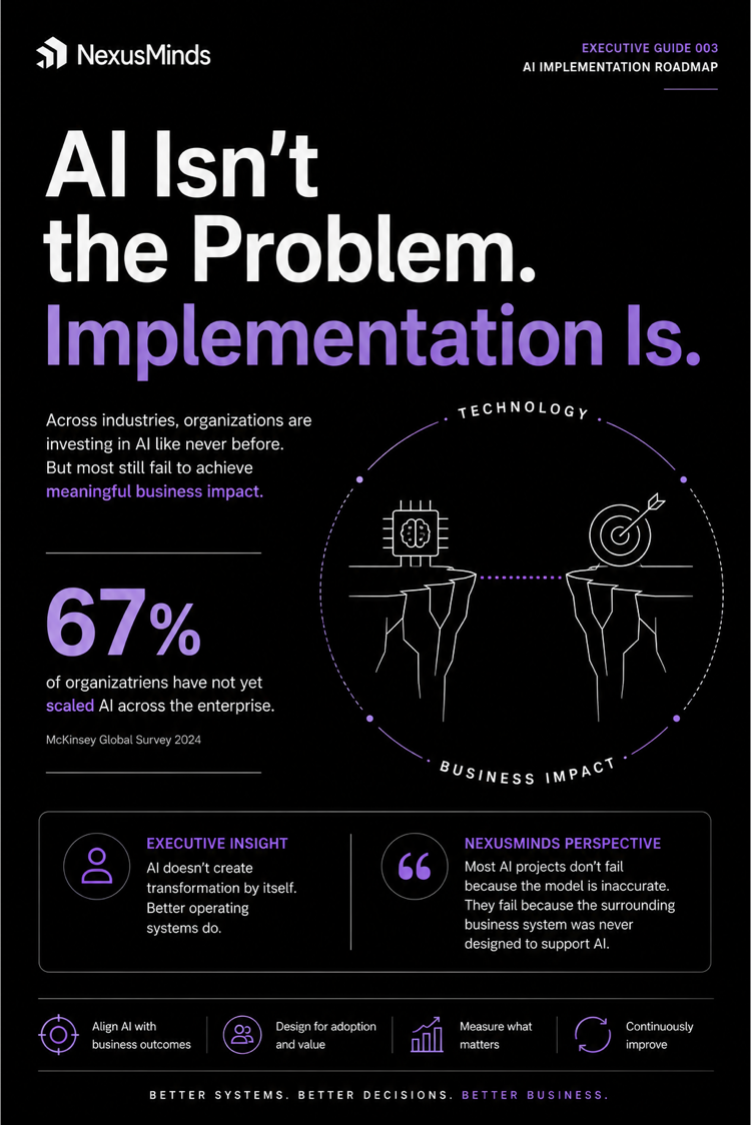
McKinsey’s latest global AI survey found that while AI usage has become mainstream, nearly two-thirds of organizations have not yet begun scaling AI across the enterprise. Even among companies reporting successful AI use cases, relatively few have achieved measurable enterprise-level financial impact.
The pattern is remarkably consistent.
Organizations launch pilots.
Teams experiment with new tools.
Employees adopt AI assistants.
But very few organizations fundamentally redesign the way work gets done.
AI doesn't create transformation by itself.
Better operating systems do.NexusMinds. Executive Insight. Tweet
The Hidden Implementation Gap
Many organizations approach AI as a technology initiative.
Successful organizations approach AI as an operating model transformation.
That distinction changes everything.
High-performing organizations are more likely to select AI initiatives based on business value, establish governance early, define success metrics, and invest in organizational adoption—not just technical deployment. Gartner’s research also shows that organizations with higher AI maturity are significantly more likely to keep AI initiatives successfully operating over the long term.
- The difference isn't better AI.
- It's better implementation discipline.
NexusMinds Perspective
Most AI projects don’t fail because the model is inaccurate.
They fail because the surrounding business system was never designed to support AI.
- Poor process design
- Fragmented workflows
- Disconnected data
- Unclear ownership
- Limited user adoption
These are implementation problems—not technology problems.
Why Executives Should Care
Every AI initiative competes for executive attention, investment, and organizational trust.
A failed implementation doesn’t just waste budget.
It creates skepticism that makes future transformation initiatives harder to deliver.
Organizations that consistently generate value from AI treat implementation as a strategic capability—not a one-time technology project. They redesign workflows, establish governance, measure outcomes, and continuously improve after deployment.
The organizations creating the greatest value from AI are not deploying more AI.
They're redesigning more workflows.NexusMinds. Executive Insight. Tweet
Introducing the NexusMinds AI Implementation Roadmap™
Successful AI adoption follows a predictable pattern.
Not because every organization uses the same technology.
But because every successful implementation moves through the same sequence of business decisions.
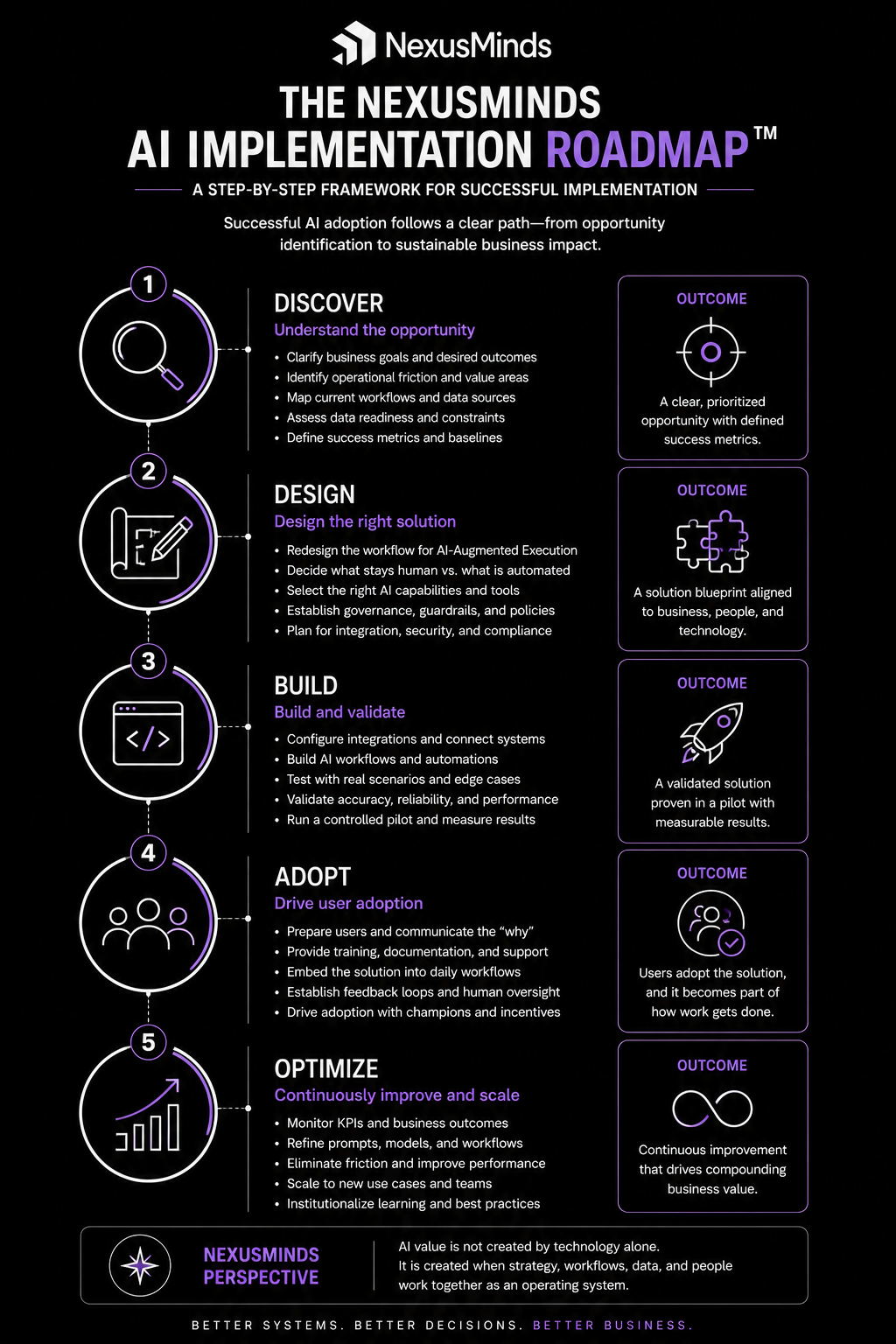
The NexusMinds AI Implementation Roadmap™ provides a practical framework for moving from opportunity identification to sustainable business impact.
The five stages are:
Discover → Design → Build → Adopt → Optimize
Each stage reduces implementation risk while increasing organizational readiness.
Together, they provide a repeatable approach to delivering AI initiatives that employees trust, leaders support, and businesses can scale.
STAGE 1: Discover
Executive Question - Are we solving the right business problem?
Every successful AI initiative begins with a business problem—not a technology decision.
Yet many organizations still start by evaluating AI tools before understanding where operational friction exists. The result is predictable: impressive pilots that struggle to deliver meaningful business outcomes.
The purpose of the Discover stage is to identify where AI can create measurable business value, establish success criteria, and determine whether the organisation is ready to move forward.
Research Insight
AI adoption is accelerating, but enterprise-wide transformation remains the exception rather than the rule.
According to McKinsey’s 2025 State of AI survey, almost nine in ten organisations now use AI in at least one business function. However, nearly two-thirds have not yet scaled AI across the enterprise, and only a minority report meaningful enterprise-level financial impact. The highest-performing organisations distinguish themselves by redesigning workflows—not simply deploying AI tools.
Don't begin by asking, "Where can we use AI?"
Begin by asking, "Where does work repeatedly slow down?"NexusMinds Perspective Tweet
Technology amplifies existing systems.
If the underlying workflow is fragmented, poorly understood, or disconnected from business objectives, AI will simply accelerate inefficiency.
The goal of discovery is not to find an AI use case.
The goal is to find a high-value business opportunity.
Executive Mistake
Starting with technology instead of business outcomes.
Many AI initiatives begin with a product demonstration or a request to “implement AI.”
Without a clearly defined business objective, teams often automate isolated tasks rather than improving end-to-end business performance.
Successful organisations reverse the sequence:
Business Problem → Workflow → AI Capability → Technology Selection
What Leaders Should Do
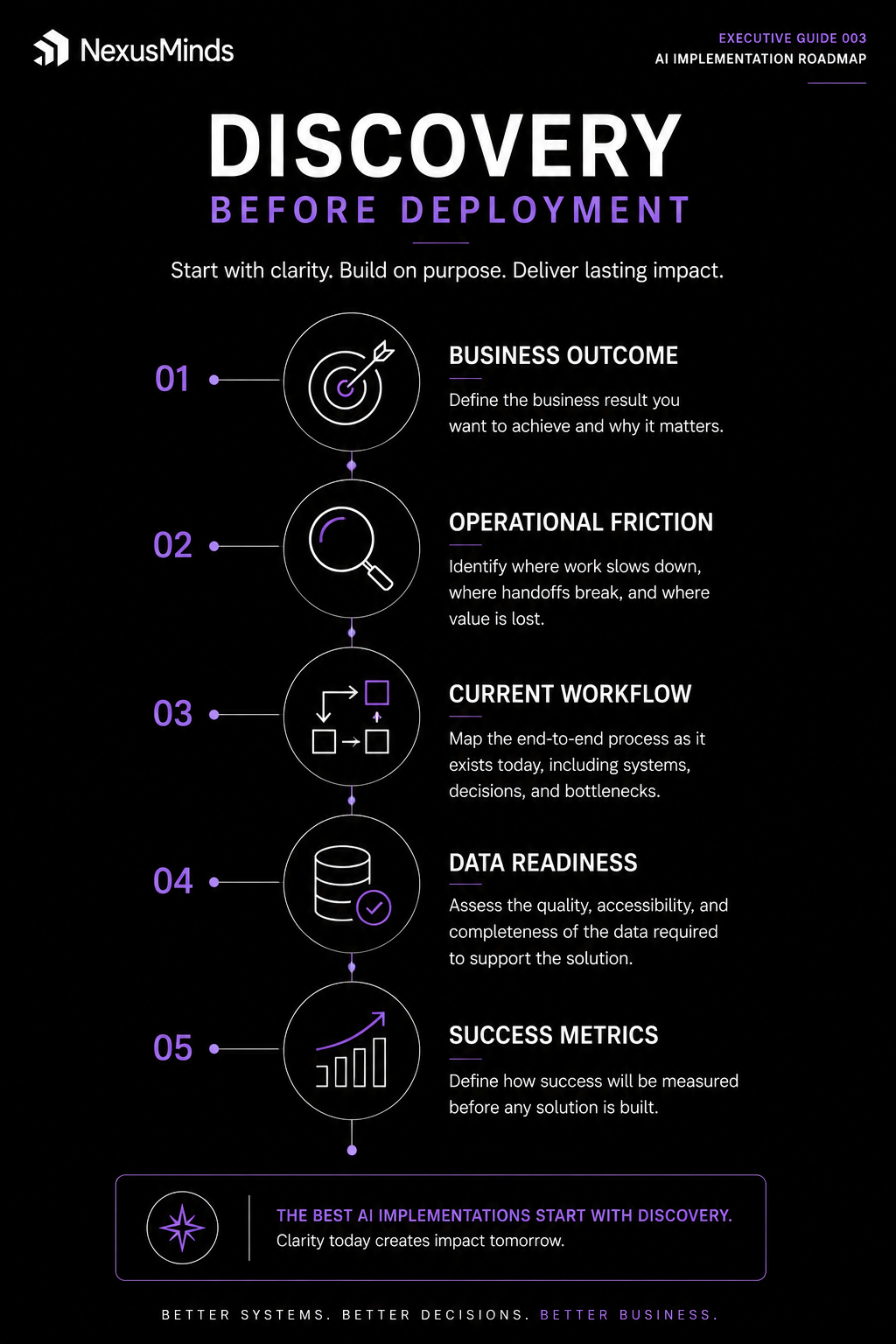
During the Discover stage, executive teams should focus on five priorities:
1. Define the Business Outcome
Be explicit about the result you want to achieve.
Examples include:
- Faster customer response times
- Reduced operating costs
- Improved forecasting accuracy
- Higher sales conversion
- Better employee productivity
Every AI initiative should support a measurable business objective.
2. Identify Operational Friction
Look beyond repetitive tasks.
Investigate where work consistently slows down because of:
- Manual effort
- Poor visibility
- Information scattered across systems
- Delayed decision-making
- Cross-functional handoffs
These friction points often represent the greatest opportunities for AI-enabled improvement.
3. Map the Current Workflow
Before redesigning a process, understand how work actually moves through the organisation.
Capture:
- Key activities
- Systems involved
- Decision points
- Handoffs
- Exceptions
- Bottlenecks
A clear view of the current state provides the foundation for successful implementation.
4. Assess Data Readiness
AI depends on trusted information.
Evaluate whether the required data is:
- Accurate
- Accessible
- Connected across systems
- Governed appropriately
- Sufficient to support reliable outcomes
Poor data quality remains one of the most common barriers to successful AI adoption.
5. Define Success Before You Build
Agree on measurable outcomes before selecting technology.
Typical implementation metrics include:
- Time saved
- Cost reduction
- Revenue impact
- User adoption
- Customer satisfaction
- Decision quality
Success should be defined before implementation begins—not after deployment.
Decision Gate
Before progressing to Design, executive teams should be able to answer Yes to each of the following:
✓ Have we identified a clearly defined business problem?
✓ Have we documented the current workflow?
✓ Have we identified the primary sources of operational friction?
✓ Do we understand the data required to support the solution?
✓ Have we established measurable success criteria?
If the answer to any of these questions is No, the organisation should remain in the Discover stage.
Moving forward prematurely increases implementation risk and reduces the likelihood of achieving measurable business value.
Executive Deliverable
Outcome of Stage 1
By the end of the Discover stage, the organisation should have:
- A prioritised AI opportunity linked to a business objective.
- A documented current-state workflow.
- A clear understanding of operational friction.
- A high-level assessment of data readiness.
- Agreed success metrics and executive sponsorship.
These deliverables create the foundation for every stage that follows.
Discovery is not about finding where AI fits.
It's about understanding where better decisions, better workflows, and better context will create the greatest business impact.NexusMinds Perspective Tweet
STAGE 2: Design
Executive Question - Are we designing a business system that AI can successfully operate within?
Successful AI implementation is rarely limited by technology.
It is limited by the quality of the operating model surrounding it.
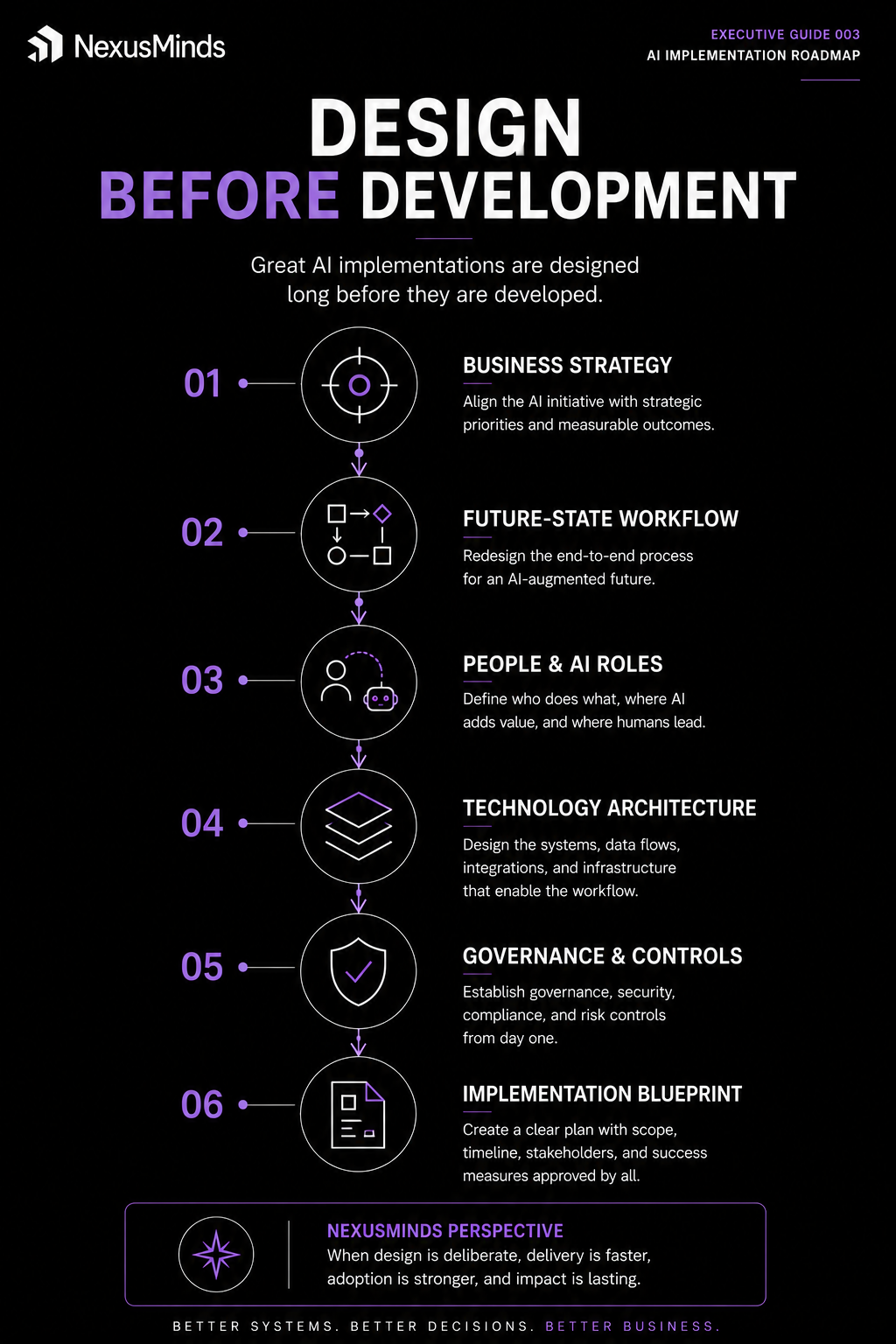
The Design stage transforms insights from Discovery into a practical implementation blueprint by defining workflows, roles, governance, decision points, and system architecture before any technology is deployed.
Research Insight
Research consistently shows that organisations achieving the highest returns from AI focus on redesigning business processes alongside technology adoption.
According to Deloitte’s State of Generative AI in the Enterprise research, organisations reporting the greatest business value invest heavily in governance, workflow redesign, employee enablement, and organisational readiness—not simply AI model deployment.
Technology creates capability.
Operating models create business value.
AI should never be designed into an existing process by default.
The process itself should first be redesigned for an AI-augmented future.NexusMinds Perspective Tweet
Many organisations automate inefficient workflows.
Leading organisations redesign the workflow first, then determine where humans and AI each create the greatest value.
Design is about creating a better way of working—not simply introducing new technology.
Executive Mistake
Designing around AI tools instead of business workflows.
One of the most common implementation failures occurs when organisations select an AI platform before defining:
- who owns each decision,
- how work should flow,
- where human oversight is required,
- and how systems will interact.
Technology should support the operating model—not define it.
What Leaders Should Do
During the Design stage, executive teams should focus on five priorities.
1. Redesign the End-to-End Workflow
Rather than automating existing processes, reimagine how work should operate in an AI-enabled environment.
Identify:
- Activities that create value
- Activities that can be automated
- Activities requiring human judgement
- New collaboration points between people and AI
The objective is a simpler, faster, and more intelligent workflow.
2. Define Human and AI Responsibilities
Not every decision should be delegated to AI.
Clearly establish:
- Decisions owned by people
- Decisions supported by AI
- Decisions automated by AI
- Escalation and approval paths
Well-defined responsibilities build trust and accountability.
3. Design the Technology Architecture
Select the systems, integrations, and data flows required to support the redesigned workflow.
Consider:
- Existing business applications
- APIs and integrations
- Security requirements
- Data movement
- Scalability
- Future extensibility
Technology should enable the business process—not complicate it.
4. Establish Governance and Risk Controls
Responsible AI requires clear governance from the outset.
Define:
- Data ownership
- Access controls
- Security standards
- Compliance requirements
- Model oversight
- Audit processes
Strong governance accelerates adoption by increasing confidence across the organisation.
5. Create an Implementation Blueprint
Before any development begins, produce a shared implementation plan that aligns business, technology, and operational teams.
The blueprint should define:
- Project scope
- Success measures
- Stakeholders
- Timeline
- Dependencies
- Expected business outcomes
Alignment at this stage significantly reduces implementation risk later.
Decision Gate
Before progressing to Build, executive teams should be able to answer Yes to each of the following:
✓ Has the future-state workflow been designed?
✓ Are human and AI responsibilities clearly defined?
✓ Has the solution architecture been documented?
✓ Are governance, security, and compliance requirements agreed?
✓ Has an implementation blueprint been approved by stakeholders?
If the answer to any of these questions is No, the organisation should remain in the Design stage until alignment is achieved.
Executive Deliverable
Outcome of Stage 2
By the end of the Design stage, the organisation should have:
- A future-state AI-enabled workflow.
- Clearly defined human and AI responsibilities.
- A documented solution architecture.
- Governance and risk management frameworks.
- An approved implementation blueprint ready for development.
These deliverables ensure the organisation enters implementation with clarity, alignment, and reduced execution risk.
Technology is only one component of implementation.
Lasting business value is created when strategy, people, processes, governance, and technology are designed as one operating system.NexusMinds Perspective Tweet
STAGE 3: Build
Executive Question - Are we building a solution that delivers measurable business value—not just technical functionality?
The Build stage is where ideas become operational capabilities.
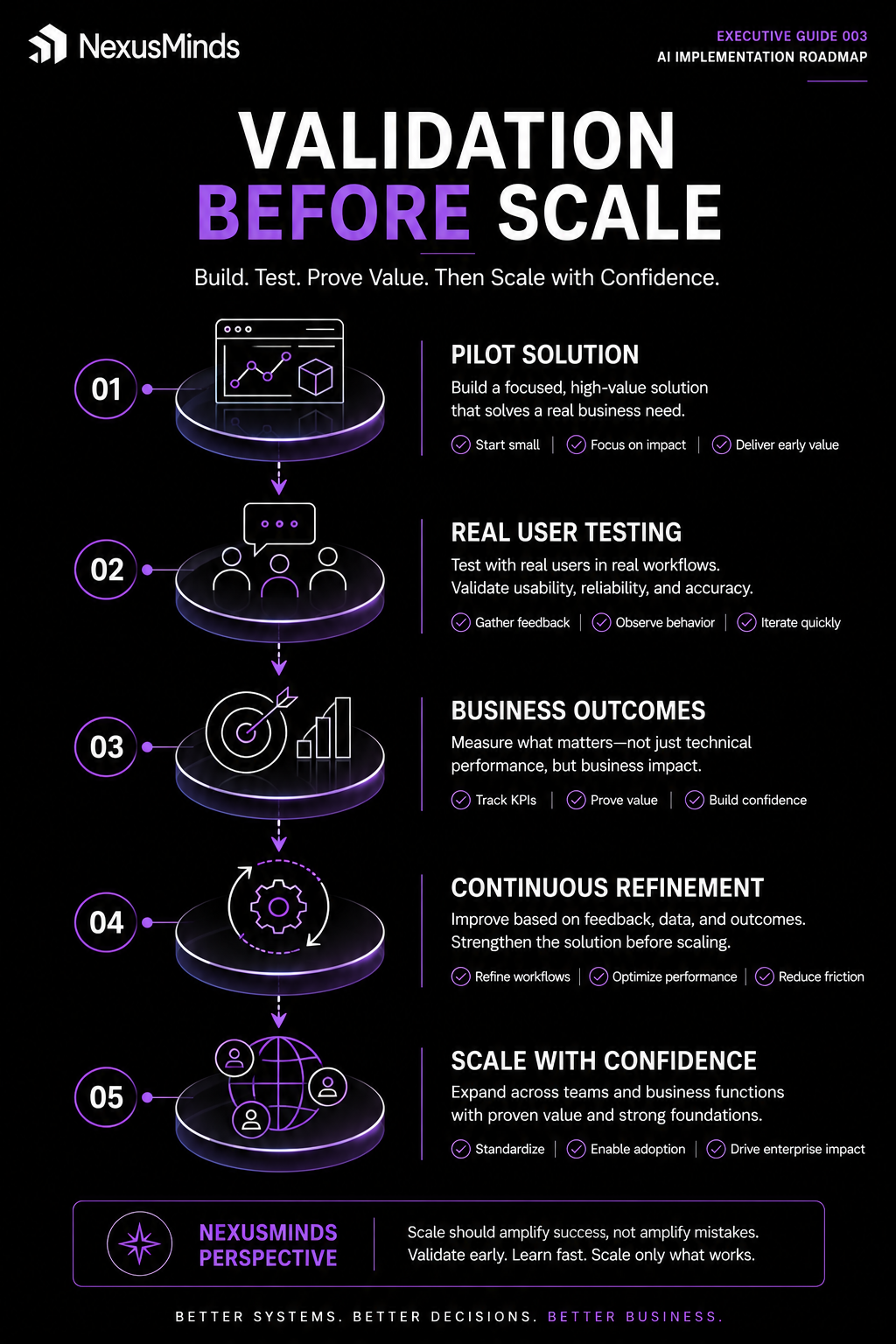
However, successful AI implementations are rarely the result of building faster. They are the result of building deliberately—validating assumptions, testing with real users, and proving business outcomes before scaling across the organisation.
The objective is not to deliver a finished AI solution.
The objective is to deliver a trusted, measurable, and scalable business capability.
Research Insight
Enterprise AI leaders consistently favour iterative delivery over large-scale implementation.
Research from Gartner and leading enterprise transformation programmes shows that organisations reduce implementation risk by deploying AI incrementally, validating outcomes with pilot groups, and refining workflows before broader rollout.
Rather than attempting organisation-wide transformation from day one, high-performing organisations treat implementation as a process of continuous learning.
Don't build for perfection.
Build for proof.NexusMinds Perspective Tweet
The first version of an AI solution should answer one question:
Does this create measurable business value?
If the answer is yes, improve it.
If the answer is no, learn quickly and adapt.
Progress matters more than perfection.
Executive Mistake
Treating implementation as an IT project instead of a business transformation.
Many organisations define success as:
- Completing development
- Launching the platform
- Deploying new technology
But implementation is not complete when software goes live.
Implementation succeeds only when business outcomes improve.
Technology deployment is a milestone.
Business adoption is the destination.
What Leaders Should Do
During the Build stage, executive teams should focus on five priorities.
1. Develop Incrementally
Break implementation into manageable phases.
Prioritise high-value capabilities that can be delivered quickly while creating measurable business impact.
Avoid attempting to automate every workflow simultaneously.
2. Integrate Existing Business Systems
AI should become part of the existing business ecosystem.
Ensure seamless integration across:
- CRM platforms
- ERP systems
- Productivity applications
- Internal databases
- Communication platforms
- Workflow automation tools
Disconnected AI creates disconnected decisions.
3. Validate with Real Users
Technical testing is only part of implementation.
Pilot the solution with representative users and evaluate:
- Ease of use
- Accuracy
- Reliability
- Decision quality
- Operational impact
User feedback should shape every iteration.
4. Measure Business Performance
Success should be evaluated using business outcomes—not technical metrics alone.
Measure indicators such as:
- Time saved
- Process efficiency
- Customer experience
- Revenue contribution
- Cost reduction
- Decision quality
- Employee productivity
Every iteration should improve measurable business performance.
5. Refine Before Scaling
Treat the initial deployment as a learning environment.
Capture lessons, improve workflows, refine prompts, optimise integrations, and strengthen governance before expanding implementation across additional teams or business functions.
Scaling should amplify success—not amplify problems.
Decision Gate
Before progressing to Adopt, executive teams should be able to answer Yes to each of the following:
✓ Has the solution been successfully tested with real users?
✓ Have business outcomes been measured?
✓ Have critical issues been resolved?
✓ Are integrations operating reliably?
✓ Is the solution ready for broader organisational adoption?
If any answer is No, continue refining the solution before expanding deployment.
Executive Deliverable
Outcome of Stage 3
By the end of the Build stage, the organisation should have:
- A validated AI solution operating within real business workflows.
- Stable integrations across key business systems.
- Documented pilot results and business performance metrics.
- User feedback incorporated into the solution.
- Executive confidence to begin organisation-wide adoption.
These deliverables ensure the organisation enters the adoption phase with evidence—not assumptions.
Implementation isn't complete when the solution works.
It's complete when the business performs better because of it.NexusMinds Perspective Tweet
STAGE 4: Adopt
Executive Question - How do we make AI part of the way people work—not just another tool they use?
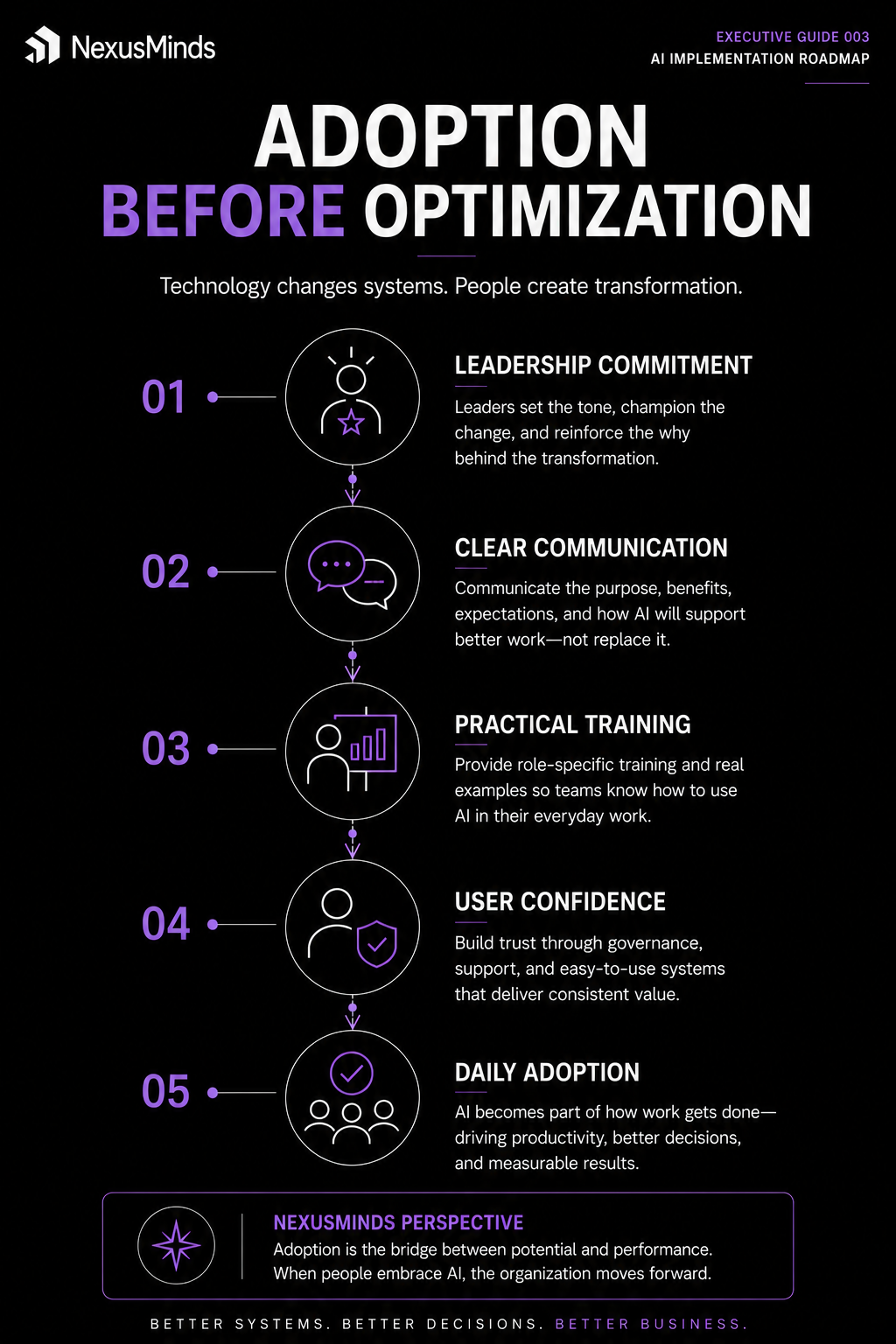
A successful implementation is measured by adoption, not deployment.
Even the most advanced AI solution will fail to deliver value if employees don’t trust it, understand it, or incorporate it into their daily workflows.
The Adopt stage focuses on embedding AI into the organisation through change management, training, governance, and continuous engagement.
Technology only creates value when people choose to use it.
Research Insight
Across enterprise transformation programmes, user adoption consistently emerges as one of the strongest predictors of implementation success.
Research from Microsoft and LinkedIn’s Work Trend Index shows that while employees are increasingly experimenting with AI, organisations that invest in training, leadership support, and clear governance see significantly higher adoption and business impact than those relying solely on technology deployment.
Successful AI transformation is as much a people initiative as it is a technology initiative.
People don't resist AI.
They resist uncertainty.NexusMinds Perspective Tweet
Most implementation challenges are not caused by the technology itself.
They arise when employees are unclear about:
- how AI should be used,
- where human judgement remains essential,
- and how new ways of working affect their roles.
Confidence grows when expectations, responsibilities, and support are clearly defined.
Executive Mistake
Assuming deployment automatically creates adoption.
Many organisations announce a new AI capability, conduct a single training session, and expect teams to embrace it.
Without ongoing communication, reinforcement, and leadership involvement, adoption slows, workarounds emerge, and expected business value never materialises.
Deployment is an event.
Adoption is a continuous process.
What Leaders Should Do
During the Adopt stage, executive teams should focus on five priorities.
1. Communicate the Business Purpose
Explain why the organisation is introducing AI and how it supports broader business objectives.
Employees are more likely to embrace change when they understand the purpose behind it.
2. Invest in Practical Enablement
Provide role-specific training that focuses on real workflows rather than software features.
Teams should know:
- when to use AI,
- when to rely on human judgement,
- and how to work effectively alongside intelligent systems.
Learning should be continuous, not a one-time event.
3. Build Trust Through Governance
Confidence grows when employees understand the rules.
Establish clear guidance around:
- acceptable AI use,
- data privacy,
- quality assurance,
- approval processes,
- and escalation paths.
Responsible governance accelerates adoption by reducing uncertainty.
4. Create Feedback Loops
Employees working closest to the process often identify improvement opportunities first.
Capture feedback regularly to refine:
- prompts,
- workflows,
- integrations,
- policies,
- and user experience.
Continuous listening strengthens long-term adoption.
5. Lead by Example
Executive sponsorship plays a critical role in sustaining momentum.
When leaders actively use AI-supported workflows, discuss outcomes, and reinforce success stories, adoption spreads more naturally across the organisation.
Culture follows leadership behaviour.
Decision Gate
Before progressing to Optimize, executive teams should be able to answer Yes to each of the following:
✓ Are employees actively using the solution in their daily workflows?
✓ Have training and enablement programmes been completed?
✓ Are governance policies understood and being followed?
✓ Is user feedback being collected and acted upon?
✓ Has adoption reached the level required to generate measurable business value?
If the answer to any of these questions is No, continue strengthening adoption before focusing on optimisation.
Executive Deliverable
Outcome of Stage 4
By the end of the Adopt stage, the organisation should have:
- AI embedded into day-to-day business operations.
- Employees trained and confident in using the solution.
- Clear governance and responsible AI practices.
- Active feedback mechanisms supporting continuous improvement.
- Executive sponsorship reinforcing organisational adoption.
These outcomes transform AI from a pilot initiative into an operational capability.
AI creates value when it becomes part of the way people think, decide, and work—not when it simply becomes another application on the technology stack.
NexusMinds Perspective Tweet
STAGE 5: Optimize
Executive Question - How do we ensure AI continues to improve business performance over time?
Successful AI implementation is not a one-time initiative.
Business priorities change.
Customer expectations evolve.
Data improves.
Technology advances.
Organizations that generate lasting value treat AI as a continuously evolving business capability rather than a completed technology project.
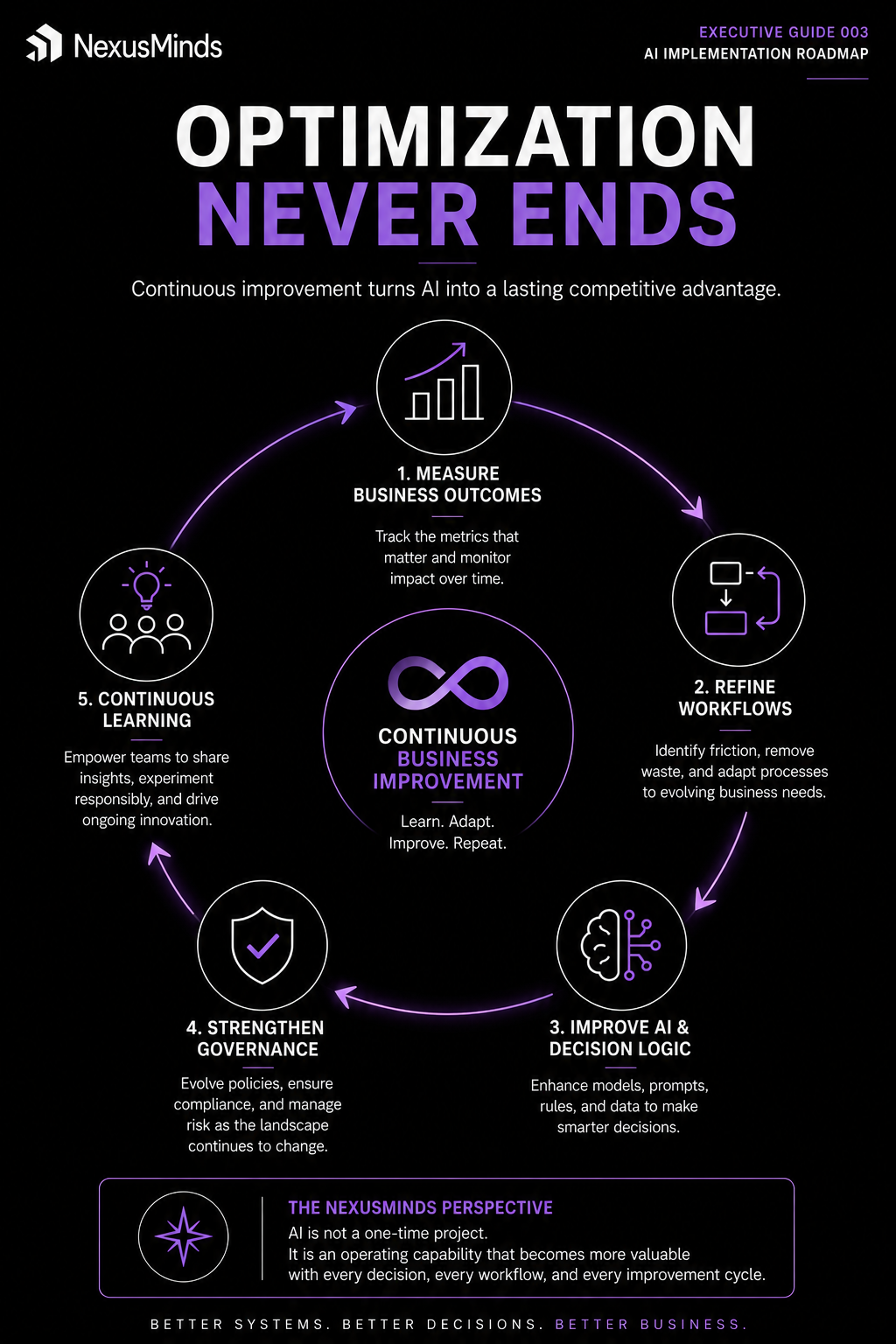
The Optimize stage focuses on measuring outcomes, learning from operational data, and continuously improving workflows, models, governance, and business performance.
Research Insight
Enterprise AI leaders consistently outperform their peers by treating AI as a continuous improvement programme rather than a fixed implementation.
Research from Accenture and Microsoft highlights that organizations generating sustained AI value regularly monitor performance, retrain models, refine workflows, and adapt governance as business conditions evolve.
Competitive advantage comes from learning faster—not simply implementing first.
The goal isn't to deploy AI.
The goal is to build an organisation that continuously improves with AI.NexusMinds Perspective Tweet
Every workflow generates new information.
Every decision creates new context.
Every interaction reveals opportunities to improve.
Optimization is the discipline of turning operational learning into better business performance.
Executive Mistake
Measuring implementation success only once.
Many organizations celebrate a successful launch and assume the work is complete.
Over time:
- business priorities shift,
- data quality changes,
- customer expectations evolve,
- and workflows become outdated.
Without continuous optimisation, even successful AI solutions gradually lose effectiveness.
Implementation should evolve alongside the business.
What Leaders Should Do
During the Optimize stage, executive teams should focus on five priorities.
1. Measure Business Outcomes Continuously
Monitor the metrics that matter most to the organisation.
Examples include:
- Revenue growth
- Operational efficiency
- Customer satisfaction
- Employee productivity
- Decision quality
- Cost reduction
- Time saved
Optimization should always be driven by business outcomes—not technology metrics alone.
2. Refine Workflows Regularly
Business processes naturally evolve.
Review workflows periodically to identify:
- unnecessary steps,
- emerging bottlenecks,
- new automation opportunities,
- and changing business requirements.
Continuous refinement keeps AI aligned with operational reality.
3. Improve Models and Decision Logic
AI systems should become smarter over time.
Review:
- prompts,
- decision rules,
- confidence thresholds,
- knowledge sources,
- and business logic.
Small improvements, applied consistently, create significant long-term value.
4. Strengthen Governance
Responsible AI is an ongoing responsibility.
Regularly review:
- security controls,
- compliance requirements,
- model performance,
- data quality,
- and organizational policies.
Governance should evolve alongside technology and regulation.
5. Build a Culture of Continuous Learning
Encourage teams to share insights, experiment responsibly, and identify new opportunities where AI can improve business performance.
The organisations that learn fastest often outperform those with the most advanced technology.
Decision Gate
Rather than marking the end of implementation, the Optimize stage asks a different question:
Are we improving faster than the business around us is changing?
Executive teams should regularly confirm:
✓ Are business outcomes improving over time?
✓ Are workflows being reviewed and refined?
✓ Are AI models and decision logic being updated?
✓ Is governance adapting to new risks and opportunities?
✓ Are employees continuously identifying new areas for improvement?
If the answer to any of these questions is No, optimization should become an executive priority.
Executive Deliverable
Outcome of Stage 5
By the end of the Optimize stage, the organisation should have:
- A continuous AI performance review process.
- Regular workflow optimisation cycles.
- Ongoing governance and risk management.
- A culture of continuous learning and experimentation.
- A scalable AI capability that evolves alongside the business.
These outcomes ensure AI remains a long-term strategic capability rather than a one-time transformation initiative.
The most successful organisations don't treat AI as a destination.
They treat it as an operating capability that becomes more valuable with every decision, every workflow, and every improvement cycle.NexusMinds Perspective Tweet
THE FUTURE BELONGS TO LEARNING ORGANIZATIONS
AI Is Not the Destination. Continuous Improvement Is.
Throughout this guide, we’ve explored a practical approach to implementing AI—from identifying business opportunities to designing workflows, building solutions, driving adoption, and continuously optimising outcomes.
While these stages provide a structured methodology, they are not the ultimate objective.
The real objective is to build an organisation that learns faster, adapts more effectively, and continuously improves the way it operates.
Technology will continue to evolve.
New AI models will emerge.
Business priorities will change.
Customer expectations will rise.
The organisations that succeed will not necessarily be those with the most advanced AI.
They will be the organisations with the strongest ability to integrate AI into everyday decisions, workflows, and business operations.
AI Is an Operating Capability
Many organisations still approach AI as a project with a defined beginning and end.
A business case is approved.
A solution is implemented.
The project is closed.
Unfortunately, business transformation doesn’t work that way.
Every AI implementation creates new data.
Every workflow generates new insights.
Every customer interaction reveals new opportunities to improve.
The most successful organisations treat AI as a permanent operating capability—one that evolves alongside the business.
Implementation is not the finish line.
It is the starting point for continuous learning.
Competitive Advantage Comes from Adaptation
History has shown that organisations rarely maintain leadership because they adopted a new technology first.
They maintain leadership because they learn, adapt, and improve faster than their competitors.
AI accelerates this reality.
The organisations that consistently measure outcomes, refine workflows, improve decision-making, and strengthen governance will steadily widen the gap between themselves and slower-moving competitors.
Over time, these small improvements compound into significant strategic advantages.
Leadership Matters More Than Technology
Technology alone does not transform organisations.
Leadership does.
Successful AI implementation requires leaders who are willing to rethink existing processes, encourage experimentation, empower their teams, and continuously invest in learning.
The most effective leaders understand that AI is not replacing human capability.
It is expanding it.
Their role is not simply to introduce new technology.
It is to create an environment where people and intelligent systems work together to achieve better business outcomes.
The future will not belong to the organisations that deploy the most AI.
It will belong to the organisations that learn, adapt, and improve faster because AI has become part of the way they operate.NexusMinds Perspective Tweet
That is the true purpose of AI implementation.
Not automation for its own sake.
Not technology for its own sake.
But building an organisation capable of making better decisions, creating better customer experiences, and delivering better business outcomes—continuously.
FINAL EXECUTIVE CHECKLIST
Before You Begin Your AI Implementation Journey
Use this checklist to assess whether your organisation is prepared to move from ambition to execution.
Business Alignment
☐ Business objectives are clearly defined.
☐ Executive sponsorship has been secured.
☐ Success metrics have been agreed.
☐ High-value business opportunities have been prioritised.
Process Readiness
☐ Current workflows have been documented.
☐ Operational bottlenecks have been identified.
☐ Future-state processes have been designed.
☐ Human and AI responsibilities are clearly defined.
Technology Readiness
☐ Required systems and integrations have been identified.
☐ Data quality and accessibility have been assessed.
☐ Security, compliance, and governance requirements are documented.
☐ An implementation roadmap has been approved.
Organisational Readiness
☐ Stakeholders understand the purpose of the initiative.
☐ Employees have a practical enablement plan.
☐ Change management activities are scheduled.
☐ Feedback mechanisms are in place.
Continuous Improvement
☐ Business performance will be measured continuously.
☐ Workflows will be reviewed regularly.
☐ AI models and decision logic will be refined over time.
☐ Governance processes will evolve alongside the business.
☐ Continuous optimisation has executive ownership.
If you can confidently complete most of this checklist, your organisation is well positioned to begin implementing AI in a structured, measurable, and sustainable way.
ABOUT NEXUSMINDS
Better Systems. Better Decisions. Better Business.
NexusMinds helps organisations transform fragmented workflows, disconnected systems, and isolated AI initiatives into intelligent business operating systems.
Rather than implementing AI as a collection of disconnected tools, we help organisations design integrated operating environments where people, processes, data, and AI work together to improve decision-making, operational efficiency, and long-term business performance.
Our focus is not simply on deploying technology.
It is on helping organisations build the capabilities required to adapt, improve, and compete in an AI-enabled future.
I look forward to seeing how these developments will improve service levels and customer satisfaction in the freight industry!